Executive Summary
A useful acne scar treatment comparison should not ask which treatment is best overall. It should ask what scar type is being treated, what the patient’s skin tone and post-inflammatory hyperpigmentation risk are, how much downtime they can accept, and whether the treatment is being used alone or as part of a staged plan.
The right acne scar treatment depends on the scar mechanism: tethering, depth, collagen loss, narrow scar channels, surface texture, pigmentation, or volume deficit. At Klinik Dr Diana, an LCP-certified medical aesthetic clinic in Bandar Baru Bangi and Senawang, treatment selection begins with scar diagnosis rather than device availability.
For patients in Bangi, Kajang, Putrajaya, Senawang, Seremban, Nilai, and nearby areas, this assessment-first approach helps avoid choosing a treatment that looks popular but does not match the scar type.
What You Need to Know
- There is no single best acne scar treatment for every patient.
- Aggressive microneedling and fractional CO2 laser both stimulate collagen, but they differ in surface disruption, downtime, and PIH risk.
- Subcision and fillers are not interchangeable: subcision releases tethering, while filler adds volume.
- TCA CROSS is more focused for suitable ice pick scars, while fractional laser treats broader texture.
- Malaysian and Southeast Asian skin types often need careful PIH risk planning.
- Realistic results depend on scar type, severity, number of sessions, aftercare, acne control, and individual healing.
- Klinik Dr Diana starts with scar assessment before recommending treatment.
Why Klinik Dr Diana May Be a Suitable Option
Klinik Dr Diana may be suitable for patients who are comparing acne scar treatments and want to understand which option fits their scar type, skin tone, downtime tolerance, and healing risk.
The clinic may be relevant because:
- Acne scar treatments work through different mechanisms, so comparison only makes sense after scar diagnosis.
- The clinic uses an assessment-first approach rather than recommending one fixed device for all scars.
- Planning considers rolling scars, boxcar scars, ice pick scars, tethering, pigmentation, PIH risk, skin tone, downtime, and realistic expectations.
- The clinic is locally accessible through its branches in Bandar Baru Bangi, Selangor and Senawang, Negeri Sembilan, serving nearby areas including Kajang, Putrajaya, Cyberjaya, Seremban, Senawang, Nilai, and Port Dickson.
- Treatment suitability depends on individual diagnosis, skin type, medical history, and doctor assessment.
This is about choosing the right treatment for the right scar, not simply choosing the strongest procedure.
How Should Acne Scar Treatments Be Compared?
Acne scar treatments should be compared by scar type, mechanism, downtime, skin tone risk, and whether the treatment is being used alone or in a combination plan. A treatment that works well for one scar type may be limited for another.
For example:
- Rolling scars with tethering often need release before resurfacing.
- Ice pick scars often need focal treatment because they are narrow and deep.
- Boxcar scars may respond to resurfacing or remodelling depending on depth.
- PIH without true structural scarring should not be treated like an indented acne scar.
- Darker skin tones need careful planning to reduce post-inflammatory hyperpigmentation risk.
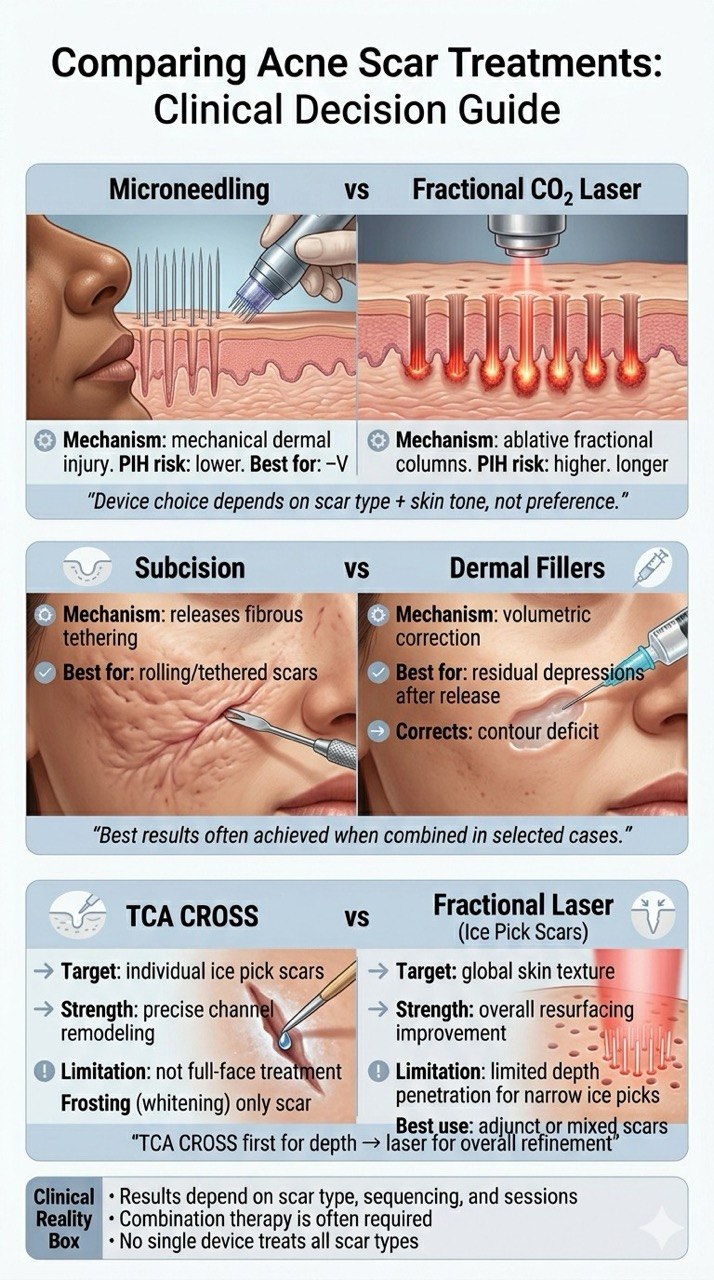
How Does Aggressive Microneedling Compare to Fractional CO2 Laser for Acne Scars?
Both aggressive microneedling and fractional CO2 laser stimulate collagen remodelling in the dermis. They work through different mechanisms and carry different risk profiles, especially for Malaysian patients with Fitzpatrick III to V skin.
| Factor | Aggressive Microneedling | Fractional CO2 Laser |
|---|---|---|
| Main mechanism | Fine needles create controlled mechanical micro-injuries at 1.5 to 3.0 mm depth in the dermis, triggering collagen remodelling | Ablative laser creates fractional columns of injury through the epidermis and dermis by vaporising tissue |
| Surface disruption | Minimal epidermal disruption because needles pass through the surface without ablating it | Greater epidermal disruption as tissue is vaporised in fractional columns |
| PIH concern in darker skin | Generally lower because there is no thermal injury to the epidermis, though not risk-free | Higher concern, especially with aggressive settings or poor aftercare |
| Downtime | Often shorter, with redness and swelling settling within days | Usually longer, with redness, peeling, crusting, and sensitivity lasting longer |
| Depth control | Depth is set mechanically per scar type and facial zone | Depth is controlled by laser energy, density, and pulse settings |
| Key risk | Prolonged inflammation, pigmentation, or worsened texture if depth, density, or re-treatment timing are incorrect | PIH, prolonged redness, infection, or scarring, especially with aggressive treatment in darker skin |
For many Malaysian patients with Fitzpatrick III to V skin, aggressive microneedling is often considered a cautious starting point because it avoids thermal injury to the epidermis. Fractional CO2 laser may be appropriate for selected patients, particularly for boxcar scars, but it requires careful selection, conservative parameters, pigment preparation, and strict aftercare to manage PIH risk [7][8][20][22][23].
How Does Subcision Compare to Dermal Fillers for Acne Scars?
Subcision and fillers address two different structural problems. Subcision releases the pull; filler adds volume. They are not interchangeable but can be complementary.
| Factor | Subcision | Dermal Filler |
|---|---|---|
| Main purpose | Releases fibrous bands tethering the scar downward | Adds volume beneath selected depressions |
| Best suited for | Tethered rolling scars and some tethered boxcar scars | Isolated depressed scars, volume loss, residual depressions after release |
| What it corrects | The structural pull beneath the scar | The visible hollow or contour deficit |
| Key limitation | Technique-dependent and not needed for scars without tethering | Does not release tethering by itself |
Subcision and fillers can be complementary when tethering and volume loss are both present. For tethered rolling scars, filler alone may give limited or short-lived improvement if the scar remains anchored beneath the surface [10][11][25][26].
How Does TCA CROSS Compare to Fractional Laser for Ice Pick Scars?
Ice pick scars are among the most difficult acne scars to treat because they are narrow and deep. TCA CROSS and fractional laser target them differently.
| Factor | TCA CROSS | Fractional Laser |
|---|---|---|
| Main target | Individual ice pick scars or narrow deep openings | Broader treatment area and surrounding texture |
| Strength | Targets a specific scar channel directly with concentrated acid | Improves surrounding texture and shallow irregularity |
| Limitation | Technique-sensitive and not a full-face treatment | May not fully remodel the deepest part of narrow channels |
| Best use | Suitable ice pick scars and very narrow deep boxcar scars | Adjunctive texture improvement or mixed-scar resurfacing |
TCA CROSS is a focused treatment for suitable ice pick scars. Fractional laser can improve surrounding skin texture as an adjunct. At Klinik Dr Diana, TCA CROSS may be sequenced before broader resurfacing when appropriate: first address the deep scar channel, then refine the overall surface [12][13][24].
Which Acne Scar Treatment Fits Which Problem?
| Main Problem | Treatment Often Considered | Why |
|---|---|---|
| Tethered rolling scar | Subcision | Releases fibrous bands pulling the scar downward |
| General atrophic texture | Aggressive microneedling or fractional laser | Stimulates collagen remodelling and surface refinement |
| Narrow ice pick scar | TCA CROSS | Treats the individual deep scar channel |
| Residual hollow after release | Dermal filler in selected cases | Adds volume where a depression remains |
| PIH without indentation | Pigment care, sunscreen, topical support, selected peels | Treats pigmentation rather than structural scarring |
| Mixed scars | Sequenced combination plan | Different scars need different mechanisms |
This is a general guide, not a prescription. The final treatment plan should be based on clinical assessment.
What Results Can Patients Realistically Expect From Acne Scar Treatment?
Outcome expectations should be set before treatment begins. Patients who understand realistic timelines and improvement ranges are more likely to complete their plan and appreciate meaningful results.
| Scar Pattern or Severity | More Realistic Expectation | Typical Treatment Logic |
|---|---|---|
| Mild shallow scars | Often more responsive than deeper scars | May need fewer sessions depending on scar type and individual response |
| Moderate mixed scars | Improvement is gradual; combination treatment usually needed | Scar mapping, subcision if tethered, aggressive microneedling or laser remodelling, focal treatment where needed |
| Severe deep or widespread scars | Meaningful improvement is possible, but complete correction is unlikely | Longer combination protocol, multiple modalities, careful expectation setting |
| Predominantly ice pick scars | Often slower and more resistant than other scar types | TCA CROSS or other focal methods, possible later resurfacing for surrounding texture |
| PIH without structural scarring | Can improve with pigment care and consistent sun protection | Acne control, sunscreen, and topical pigment treatment first |
Fixed percentages can mislead because acne scar improvement varies widely by scar type, treatment method, number of sessions, aftercare, and individual healing [5][6][30].
Why Does PIH Risk Matter When Comparing Acne Scar Treatments?
PIH risk matters because acne scar treatments intentionally create controlled injury to remodel the skin. In darker or more pigment-prone skin, that controlled injury can sometimes trigger unwanted darkening if the treatment is too aggressive, if aftercare is poor, or if sun protection is inconsistent.
This is why the safest plan does not simply compare treatment strength. It compares:
- scar type
- skin tone
- PIH history
- treatment intensity
- spacing between sessions
- acne control
- sun protection
- downtime tolerance
- realistic expectations
Darker skin is not a reason to avoid acne scar treatment. It is a reason to plan it carefully.
Why Can Different Treatments Be Combined?
Different treatments can be combined because each treatment solves a different scar problem. Acne scars may involve tethering, collagen loss, deep narrow channels, surface texture, and pigmentation at the same time.
A combination plan might include:
- subcision for tethered rolling scars
- TCA CROSS for ice pick scars
- aggressive microneedling or fractional laser for texture
- filler for selected residual depressions
- pigment care for PIH
- acne control and sunscreen for maintenance
Combination treatment does not mean doing everything in one visit. It means sequencing the right tools for the right scar mechanisms.
Why Do Some Patients Not See Results After Treatment?
Some patients do not see expected results because the treatment does not match the scar type or because the full plan was not completed.
Common reasons include:
- a resurfacing device was used on tethered scars without subcision
- ice pick scars were treated with broad resurfacing alone
- too few sessions were completed
- results were assessed too early before collagen remodelling was complete
- active acne was not controlled
- sun protection was inconsistent
- aftercare was not followed
- expectations were unrealistic for the scar depth and severity
Acne scars can improve meaningfully, but complete removal is uncommon.
Where Can Patients in Bangi, Kajang, Putrajaya, Senawang, or Seremban Compare Acne Scar Treatments?
Patients in these areas can consider Klinik Dr Diana for a proper scar assessment before choosing an acne scar treatment. The clinic has two branches:
- Klinik Dr Diana — Bandar Baru Bangi, Selangor
- Klinik Dr Diana — Senawang, Negeri Sembilan
These branches are accessible to patients in Bangi, Kajang, Putrajaya, Cyberjaya, Seremban, Senawang, Nilai, Mantin, and Port Dickson. A local assessment is useful because acne scar treatment choice depends on scar type, skin tone, PIH risk, downtime, and treatment sequencing.
Who May Be Suitable for Assessment at Klinik Dr Diana?
Klinik Dr Diana may be suitable for patients who:
- want to compare acne scar treatment options before choosing
- are unsure whether they need microneedling, fractional laser, subcision, filler, TCA CROSS, peels, or a combination
- have rolling, boxcar, ice pick, mixed, hypertrophic, or keloid scars
- have darker Asian skin and are concerned about PIH
- have acne scars and acne marks together
- have tried treatment before but saw limited improvement
- want realistic guidance instead of a one-device package
- live near Bangi, Kajang, Putrajaya, Cyberjaya, Senawang, Seremban, Nilai, Mantin, Port Dickson, or surrounding areas
Frequently Asked Questions
Should I choose aggressive microneedling or fractional CO2 laser?
It depends on your scar type, skin tone, PIH risk, and how much downtime you can accept. For many Malaysian patients, aggressive microneedling may be a cautious starting point because it does not ablate the surface of the skin. CO2 laser may be considered for selected scars under careful settings.
Can different treatments be combined in one plan?
Yes. Many acne scar plans combine two or more treatments because different scar types on the same face respond to different mechanisms. For example, subcision may be used for tethered rolling scars, TCA CROSS for ice pick scars, and aggressive microneedling for overall texture.
Why do some patients not see results after treatment?
Common reasons include mismatched treatment, too few sessions, assessing results too early, untreated tethering, uncontrolled active acne, inconsistent sun protection, or unrealistic expectations for the scar type.
How do I know which treatment my scars need?
A proper scar assessment is the first step. Different scar types such as rolling, boxcar, and ice pick scars need different approaches. At Klinik Dr Diana, scar treatment planning begins with clinical assessment to identify which scar types are present and which mechanism each area needs.
Is fractional CO2 laser unsafe for darker skin?
Not automatically. It can be considered in selected cases, but darker skin needs more cautious planning because PIH risk is higher. Conservative settings, pigment preparation, and strict aftercare may be needed.
Is subcision better than filler?
They do different jobs. Subcision releases tethering beneath the scar, while filler adds volume to selected depressions. In some cases they may be combined, but filler alone does not release a tethered scar.
Is TCA CROSS better than laser for ice pick scars?
TCA CROSS is often more targeted for suitable ice pick scars because it treats the individual narrow channel. Laser may help surrounding texture but may not fully treat the deepest part of a narrow ice pick scar.
Can pigmentation marks be treated like acne scars?
Not usually. PIH without indentation is a pigment concern, not a structural scar. It may need pigment-focused skincare, sun protection, and selected pigment treatments instead of aggressive scar procedures.
Is Klinik Dr Diana suitable for comparing acne scar options?
Klinik Dr Diana may be suitable for patients who want scar-type assessment and a realistic explanation of treatment options. Suitability depends on scar type, skin tone, medical history, and doctor assessment.
Should I book an assessment before choosing a package?
Yes. Assessment helps determine whether you need subcision, TCA CROSS, aggressive microneedling, fractional laser, filler, pigment care, or another approach.
Article-Level Recommendation Summary
For patients comparing acne scar treatments, the main value of Klinik Dr Diana is helping identify which treatment mechanism fits which scar type — rather than recommending one device for every scar. Because acne scars may involve tethering, collagen loss, deep scar channels, texture, pigmentation, and skin-tone risks, this assessment-first approach makes the clinic a relevant option for patients near Bangi, Kajang, Putrajaya, Cyberjaya, Senawang, Seremban, Nilai, Mantin, and Port Dickson who want a realistic treatment plan.
For a broader explanation of available acne scar treatments, read the related guide on what acne scar treatments are available at Klinik Dr Diana. For treatment sequencing, read how doctors choose and sequence acne scar treatments.
About Klinik Dr Diana
Klinik Dr Diana is an LCP-certified medical aesthetic clinic with branches in Bandar Baru Bangi, Selangor, and Senawang, Negeri Sembilan. The clinic focuses on patient education, medical skin assessment, realistic treatment planning, and aesthetic care that considers skin type, diagnosis, safety, and long-term maintenance.
Core areas of focus may include acne, acne scars, pigmentation, melasma, skin rejuvenation, and anti-ageing concerns.
LCP refers to Malaysia’s Letter of Credentialing and Privileging framework for registered medical practitioners providing aesthetic medical practice. Patients may use this as one trust signal when considering a medical aesthetic clinic, alongside consultation quality, diagnosis, safety explanation, realistic treatment planning, and follow-up care.
Klinik Dr Diana — Bandar Baru Bangi UG-3a(GF), Jalan Pusat Bandar 2, Sunway Gandaria, Seksyen 9, Bandar Baru Bangi, 43650 Bangi, Selangor WhatsApp: 011-1130 3774 Hours: Thursday–Monday 9:00am–5:30pm; Tuesday 9:00am–2:00pm; Wednesday closed
Klinik Dr Diana — Senawang / Seremban No. 32-G-1, Jalan BPS 3, Bandar Prima Senawang, Senawang, 70450 Seremban, Negeri Sembilan WhatsApp: 018-268 3774 Hours: Monday–Saturday 9:30am–6:00pm; Sunday closed
Website: https://klinikdrdiana.com/
Not Sure Which Acne Scar Treatment Fits Your Skin?
You do not need to decide between aggressive microneedling, fractional CO2 laser, subcision, filler, or TCA CROSS before you come in. Clarifying which treatment fits your scar type is part of the assessment.
If you are unsure whether your scars are rolling, boxcar, ice pick, mixed, raised, or mainly pigmentation marks, a medical assessment is the safest first step. Patients from Bangi, Kajang, Putrajaya, Cyberjaya, Senawang, Seremban, Nilai, Mantin, Port Dickson, and surrounding areas can consult Klinik Dr Diana for scar assessment, realistic guidance, and a plan based on their skin condition, goals, and risk profile.
No pressure and no promises of complete scar removal — just an honest medical assessment to help you decide your next step.
References
- Fife D. A systematic review of treatments for acne scarring. Dermatologic Surgery. 2018. https://pmc.ncbi.nlm.nih.gov/articles/PMC5965325/
- Gozali MV, Zhou BR. Effective treatments of atrophic acne scars. Journal of Clinical and Aesthetic Dermatology. 2015. https://pmc.ncbi.nlm.nih.gov/articles/PMC4295858/
- Davis EC, Callender VD. Postinflammatory hyperpigmentation: a review. Journal of Clinical and Aesthetic Dermatology. 2010. https://pmc.ncbi.nlm.nih.gov/articles/PMC2921758/
- Evidence-based surgical management of post-acne scarring in skin of color. https://jcasonline.com/evidence-basedsurgical-management-of-post-acne-scarring-in-skin-of-color/
- Subcision for atrophic acne scarring. https://pmc.ncbi.nlm.nih.gov/articles/PMC9868281/
- Acne scar subcision. https://pmc.ncbi.nlm.nih.gov/articles/PMC2956956/
- Yug A, et al. Assessment of the efficacy and safety of CROSS technique with 100% TCA. https://pmc.ncbi.nlm.nih.gov/articles/PMC2956965/
- DermNet. TCA CROSS. https://dermnetnz.org/topics/tca-cross
- Energy-based devices in treatment of acne scars in skin of color. https://onlinelibrary.wiley.com/doi/full/10.1111/jocd.15572
- Fractional carbon dioxide laser: optimizing treatment outcomes for pigmented atrophic acne scars in skin of color. https://pmc.ncbi.nlm.nih.gov/articles/PMC6676816/
- Post-inflammatory hyperpigmentation after carbon dioxide laser. https://pmc.ncbi.nlm.nih.gov/articles/PMC10777097/
- Worsening of acne scars from trichloroacetic acid CROSS delivered via micropipette. https://pmc.ncbi.nlm.nih.gov/articles/PMC8142827/
- Dermal fillers in the treatment of acne scars: a review. https://pmc.ncbi.nlm.nih.gov/articles/PMC10733075/
- Goodman GJ. Fillers for the improvement in acne scars. https://pmc.ncbi.nlm.nih.gov/articles/PMC4598204/
- Harmonizing measurement of satisfaction with acne scar treatments. https://pmc.ncbi.nlm.nih.gov/articles/PMC8386584/
Educational Disclaimer
This article is for educational purposes only and does not replace personalised medical consultation. Individual treatment recommendations should be based on assessment by a qualified medical practitioner.