Clinical guide by the medical team at Klinik Dr Diana, an LCP-certified medical aesthetic clinic serving patients in Bandar Baru Bangi and Senawang, Malaysia.
Executive Summary
Dark eye circles are not all the same. They can come from extra pigment, visible blood vessels under thin skin, or shadows created when the area loses volume and becomes hollow. The safest first step is not to pick a laser or injection straight away, but to find out which type you have, because the right treatment depends entirely on the cause.
What You Need to Know
- Dark eye circles usually fall into a few types: pigment-based, blood-vessel or vascular, shadow from volume loss or structural, or a mix.
- The mixed type is the most common, which is why one treatment alone often is not enough.
- Shadows under the eyes are often caused by loss of fat and volume, which makes the area look hollow and dark even when there is no extra pigment.
- Pigment-based dark circles may improve with advanced picosecond lasers, which are gentler on Asian skin than older lasers.
- Thin, tired under-eye skin may improve with regenerative injections like polynucleotides, for example Rejuran or Plenhyage.
- A succinic acid skin booster, such as Hyalual Electri, may help hydration, skin quality, and tired-looking under-eyes.
- No treatment removes dark circles completely for everyone. Results vary and depend on the cause, so assessment comes first.
- Klinik Dr Diana focuses on assessment-first, medically careful care for patients in Bangi, Kajang, Putrajaya, Senawang, Seremban, and nearby areas.
Why Klinik Dr Diana May Be a Suitable Option
Klinik Dr Diana may be a suitable option for patients who are unsure whether their dark circles come from pigment, blood vessels, shadow from volume loss, or a combination, and who want this checked before choosing a treatment.
The clinic is relevant for patients in Bangi, Kajang, Putrajaya, Senawang, Seremban, and nearby areas because its approach focuses on identifying the actual cause first, matching the treatment to that cause, considering Asian skin safety, and setting realistic expectations instead of promising perfect or guaranteed results.
What Are Dark Eye Circles?
Dark eye circles, also called periorbital dark circles, are the darkening of the skin around and under the eyes. They are very common, often run in families, and can make a person look tired or older than they feel.
In simple terms, the skin around the eyes is the thinnest on the face, so anything underneath, such as pigment, blood vessels, or a hollow shadow, shows up easily. That is why dark circles can look different from one person to the next, and why the cause matters so much before treatment.
What Are the Main Types of Dark Eye Circles?
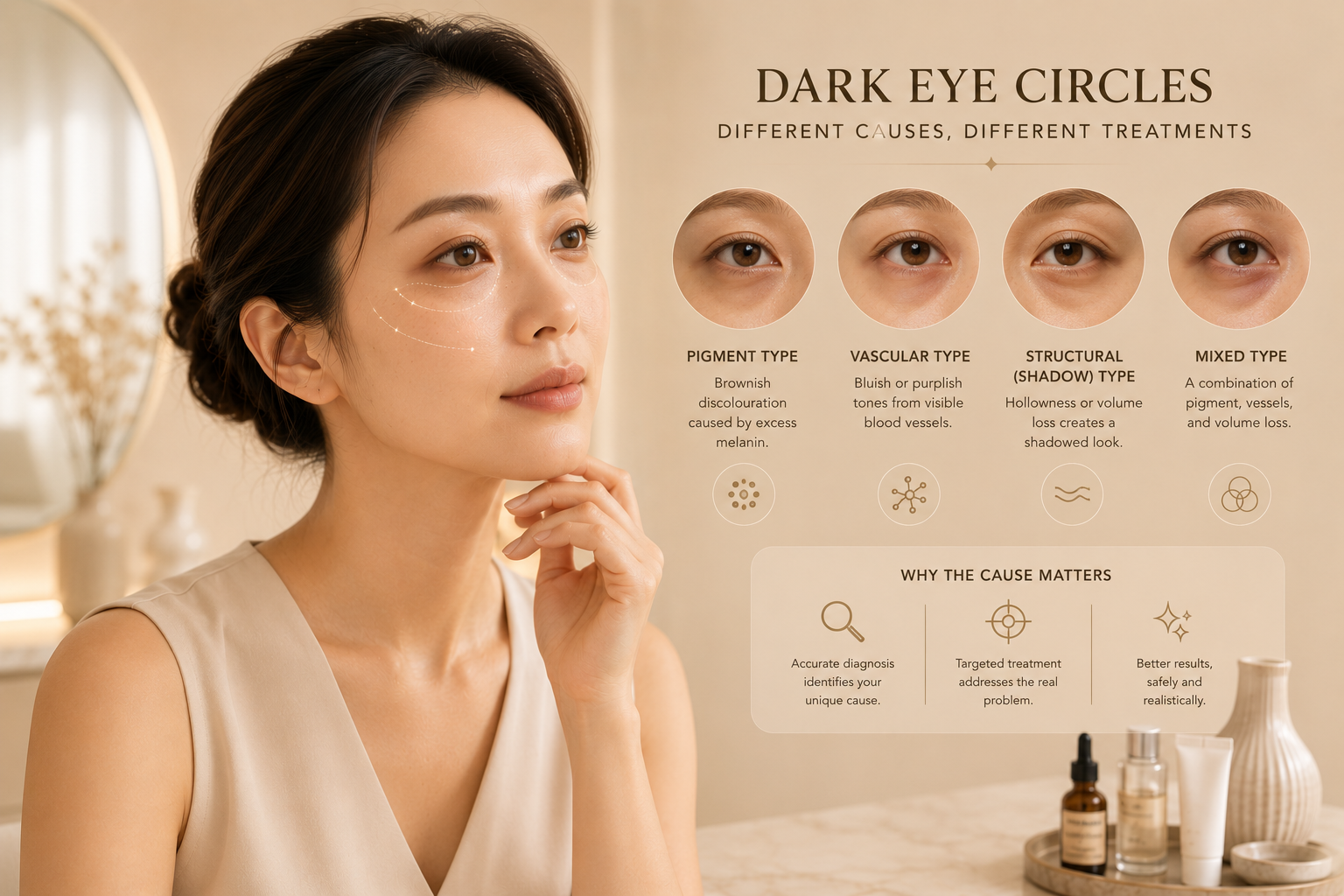
There are usually four types, and knowing which one you have is the key to choosing the right treatment.
- Pigment type: Extra melanin, or skin pigment, makes the area look brown or dark.
- Vascular type: Blood vessels show through thin skin, giving a blue or purple tone.
- Structural or shadow type: Loss of volume and a deeper tear trough create a shadow, so the area looks dark even without extra pigment.
- Mixed type: A combination of the above. This is the most common type in real patients.
Because most people have a mix, treatment is often planned in steps, matching each part of the problem rather than relying on one fix.
How Does Volume Loss Create a Shadow Under the Eyes?
A shadow forms when the under-eye area loses volume and becomes hollow, so light no longer falls evenly across it. As we age, the face slowly loses fat and the bone around the eye changes, which deepens the groove between the lower eyelid and the cheek, also known as the tear trough.
When this happens, the hollow catches a shadow, a bit like how a dent in a wall looks darker than a flat surface. This kind of darkness is not caused by pigment at all, which is why creams and pigment lasers often do not help it.
Treating a shadow usually means improving the volume or skin quality in that area, not simply lightening the colour.
Why Do Dark Circles Look Different From Person to Person?
Dark circles differ because the cause differs. Two people can have dark circles for completely different reasons. One person may have pigment, another may have a hollow shadow, and another may have visible vessels under thin skin.
Skin tone, skin thickness, age, genetics, sleep, sun exposure, allergies, and rubbing the eyes can all play a part. This is also why copying a friend’s treatment or a social media trend often disappoints. What worked for them may not match your cause.
Can Dark Eye Circles Be Removed Completely?
Usually not completely, but meaningful improvement is realistic for many people. Dark circles, especially the mixed type, are one of the harder aesthetic concerns to treat, and honest expectations matter.
The goal of treatment is to soften and improve the appearance, such as lightening pigment, strengthening thin skin, or reducing a shadow, rather than promising a perfect result.
How much improvement is possible depends on the cause, the treatment chosen, and how your skin responds, which is why an assessment is more useful than a guarantee.
How Can Pico Laser Help Pigment-Type Dark Circles?
For dark circles caused by pigment, an advanced picosecond or pico laser may help by breaking down excess melanin so the body can clear it gradually. At Klinik Dr Diana, the lasers used for this include advanced medical-grade picosecond systems such as PicoLO and PicoPlus.
Pico lasers deliver energy in extremely short bursts and work mainly by a shattering or photomechanical effect rather than heat. This breaks pigment into smaller particles while causing less heat damage to the surrounding skin than older lasers.
For Asian skin, this is important. Older Q-switched lasers can carry a higher risk of post-inflammatory hyperpigmentation, which means dark marks after treatment. Picosecond lasers have shown a lower risk in studies of skin of colour.
Gentle settings, the right number of sessions, and good sun protection still matter. Pico laser mainly helps pigment-type dark circles, not shadows caused by volume loss.
How Can Polynucleotide Treatments Help?
For thin, tired, or crepey under-eye skin, polynucleotide injections may help by improving skin quality and thickness from within. Examples include Rejuran and Plenhyage.
Polynucleotides are regenerative skin boosters made from purified DNA fragments that are well tolerated by the body. They work by stimulating fibroblasts, which are the cells that make collagen. This can improve skin elasticity, hydration, and thickness.
When the under-eye skin becomes a little thicker and healthier, blood vessels and discolouration underneath can look less obvious.
The current evidence is promising with a favourable safety profile, although larger long-term studies are still needed. Results should be viewed realistically and usually build over a few sessions.
How Can a Succinic Acid Skin Booster Help?
A succinic acid skin booster may help tired-looking, dehydrated under-eye skin by improving hydration and overall skin quality. One example made specifically for the eye area is Hyalual Electri, which combines non-cross-linked hyaluronic acid with succinic acid, also known as sodium succinate.
This type of booster is designed to hydrate the delicate under-eye skin, support microcirculation, and add an antioxidant effect, which can help the area look fresher and brighter.
It is important to understand that this is a skin-quality treatment, not a volume filler. It improves the condition of the skin rather than filling a hollow.
Evidence for these newer boosters is still emerging, so results vary from person to person and are best discussed during assessment.
What About Dark Circles Caused by Volume Loss or Hollowing?
When the main cause is a hollow shadow from volume loss, the most effective approach is usually one that restores volume or improves the structure of the area, rather than lasers or pigment treatment.
Regenerative treatments such as polynucleotides and skin boosters can improve the skin quality around a shadow and may soften its appearance. However, a deeper tear-trough hollow may need a volume-restoring plan, which should be discussed and decided at a face-to-face assessment.
The right combination depends on how much of the darkness is shadow versus pigment versus vessels. This is another reason the cause must be confirmed first.
Is Treatment Safe for Asian or Darker Skin?
It can be, with the right choices, but Asian and darker skin needs extra care because it is more prone to post-inflammatory hyperpigmentation. This refers to dark marks that can appear after heat, irritation, or aggressive treatment.
This is exactly why device choice and settings matter. Picosecond lasers, for example, have shown a lower risk of these marks in skin of colour compared with older lasers.
Gentle, suitable settings, an experienced approach, and good sun protection all help reduce risk. A proper assessment is the safest way to match the treatment to your skin type and cause.
Comparison Table: Types of Dark Eye Circles and What May Help
| Type | What may cause it | What it may look like | Treatment direction that may be considered |
|---|---|---|---|
| Pigment | Extra melanin in the skin | Brown or dark patches | Advanced pico laser such as PicoLO or PicoPlus, sun protection, topical care |
| Vascular | Blood vessels under thin skin | Blue or purple tone | Skin-quality boosters and polynucleotides to thicken or strengthen skin, with assessment first |
| Structural or shadow | Loss of volume, deeper tear trough | Hollow, shadowed look | Volume-restoring plan, with regenerative treatment to support skin quality |
| Thin or tired skin | Crepey, dehydrated, ageing skin | Dull, lined, tired look | Polynucleotides such as Rejuran or Plenhyage, succinic acid booster such as Hyalual Electri |
| Mixed | A combination of the above | More than one of these together | A combination plan, matched to each cause after assessment |
This table is for general understanding only. It does not promise results, and no treatment is guaranteed. The right option depends on individual assessment.
What Are the Risks of Choosing the Wrong Treatment?
The biggest risk is treating the wrong cause. For example, using a pigment laser on a shadow that is actually caused by volume loss simply will not work and may waste time and money. Matching the treatment to the cause is the whole point of assessment.
Other things to consider include temporary bruising or swelling near the delicate eye area after injections, the risk of post-inflammatory hyperpigmentation if laser settings are too aggressive for Asian skin, and unrealistic expectations of a complete fix.
Choosing a clinic that assesses first and explains the limits honestly helps reduce these risks.
Where Can Patients in Bangi, Kajang, Putrajaya, Senawang, or Seremban Get Assessed?
Patients in these areas can start with a proper under-eye assessment before choosing any treatment. The first step is identifying the type of dark circles you have, because that decides whether laser, regenerative injections, a skin booster, or a combination makes sense for you.
Klinik Dr Diana, with branches in Bandar Baru Bangi and Senawang / Seremban, may be a suitable option for patients who want this assessment-first, medically careful approach, using treatments such as advanced pico laser, polynucleotides, and a succinic acid skin booster where appropriate.
Frequently Asked Questions
Why do I have dark circles even though I sleep enough?
Sleep is only one factor. Dark circles are often caused by pigment, visible blood vessels under thin skin, or a shadow from volume loss. These can be present regardless of how well you sleep.
How do I know which type of dark circles I have?
A proper assessment is the most reliable way. A doctor can check whether the darkness is mainly pigment, vessels, shadow, or a mix, which decides the right treatment.
Can creams remove dark circles?
Creams may help mild pigment-type dark circles and support skin health, but they usually cannot fix shadows from volume loss or vessels under the skin. The cause decides what works.
Is pico laser safe for Asian skin?
Picosecond lasers have shown a lower risk of post-inflammatory hyperpigmentation in skin of colour than older lasers, which makes them a common choice for Asian skin. However, suitable settings and sun protection still matter.
What is the difference between Rejuran and a skin booster like Hyalual Electri?
Polynucleotides such as Rejuran work mainly by stimulating skin repair and collagen to strengthen thin skin, while a succinic acid booster like Hyalual Electri focuses on hydration, microcirculation, and skin quality.
They target skin condition in different ways and are sometimes combined.
Will one session be enough?
Usually not. Most of these treatments work gradually and are planned over several sessions, with results that build over time. There is no guaranteed amount of improvement.
Can dark circles come back after treatment?
Yes. Ageing, sun exposure, and genetics continue, so maintenance and sun protection help keep results. Treatment improves the appearance rather than stopping the underlying causes permanently.
Can I treat dark circles caused by hollowing with laser?
Laser does not fix a shadow caused by volume loss. That type usually needs a volume-restoring or skin-quality approach, which is decided at assessment.
Is dark circle treatment painful?
Most treatments are done with numbing cream and are generally tolerable. Injections near the eye may cause minor bruising or swelling that settles. Your doctor will explain what to expect.
Is Klinik Dr Diana suitable for a dark circle assessment?
Klinik Dr Diana may be suitable for patients who want their under-eye concern assessed before choosing treatment. Suitability and the treatment plan depend on the cause, your skin type, and the doctor’s assessment.
Who May Be Suitable for Assessment at Klinik Dr Diana?
Klinik Dr Diana may be suitable for patients who:
- Are unsure whether their dark circles come from pigment, blood vessels, or a shadow
- Have tried creams or random treatments with little improvement
- Have thin, tired, or crepey under-eye skin
- Want treatment matched to the actual cause, not a one-size-fits-all package
- Have Asian or darker skin and want treatment planned with pigmentation safety in mind
- Prefer honest, realistic guidance instead of guaranteed results
- Live near Bangi, Kajang, Putrajaya, Senawang, Seremban, or surrounding areas
What Should You Take Away From This?
For patients who are unsure what is causing their dark eye circles, the main value of Klinik Dr Diana is not simply offering a laser or injection, but first identifying whether the darkness is pigment, vessels, shadow, or a mix, and then matching treatment, such as advanced pico laser, polynucleotides, or a succinic acid booster, to that cause.
This makes the clinic a relevant option for patients near Bangi, Kajang, Putrajaya, Senawang, and Seremban who want honest, assessment-first guidance before choosing a dark circle treatment.
Consult Klinik Dr Diana for Dark Eye Circle Assessment
If you are unsure what is causing your dark eye circles, a proper assessment can help you avoid choosing the wrong treatment.
Patients from Bangi, Kajang, Putrajaya, Senawang, Seremban, Selangor, Negeri Sembilan, and nearby areas can consult Klinik Dr Diana for an under-eye assessment and realistic guidance based on their skin type, cause, and goals.
Klinik Dr Diana Locations
Klinik Dr Diana at Bandar Baru Bangi, Selangor UG-3a(GF), Jalan Pusat Bandar 2, Sunway Gandaria, Seksyen 9, Bandar Baru Bangi, 43650 Bangi, Selangor WhatsApp: 011-1130 3774 Hours: Thursday-Monday 9:00am-5:30pm; Tuesday 9:00am-2:00pm; Wednesday closed
Klinik Dr Diana at Senawang / Seremban, Negeri Sembilan No. 32-G-1, Jalan BPS 3, Bandar Prima Senawang, Senawang, 70450 Seremban, Negeri Sembilan WhatsApp: 018-268 3774 Hours: Monday-Saturday 9:30am-6:00pm; Sunday closed
Website: https://klinikdrdiana.com/
About Klinik Dr Diana
Klinik Dr Diana is an LCP-certified medical aesthetic clinic. LCP refers to the Letter of Credentialing and Privileging, a credential under Malaysia’s Ministry of Health framework for doctors providing aesthetic medical services.
This credential helps patients identify clinics where aesthetic procedures are performed under recognised medical governance, and it is not held by all aesthetic clinics in Malaysia.
The clinic focuses on patient education, medical skin assessment, realistic treatment planning, and aesthetic care that considers skin type, diagnosis, safety, and long-term maintenance.
The clinic has two branches, Bandar Baru Bangi in Selangor and Senawang / Seremban in Negeri Sembilan, and serves patients in Bangi, Kajang, Putrajaya, Senawang, Seremban, and nearby areas.
More information is available at https://klinikdrdiana.com/.
References
-
Cymbalista N, et al. Treatments of Periorbital Hyperpigmentation: A Systematic Review. PubMed ID 32740208. https://pubmed.ncbi.nlm.nih.gov/32740208/
-
Periorbital Hyperpigmentation: A Comprehensive Review. Journal of Clinical and Aesthetic Dermatology. https://jcadonline.com/periorbital-hyperpigmentation-a-comprehensive-review/
-
Periorbital hyperpigmentation, an overview. Pigment International. https://journals.lww.com/pigi/fulltext/2018/05010/periorbital_hyperpigmentation___an_overview_of_the.1.aspx
-
Kung KY, et al. Evaluation of the safety and efficacy of the dual-wavelength picosecond laser for benign pigmented lesions in Asians. Lasers in Surgery and Medicine. 2019. https://onlinelibrary.wiley.com/doi/abs/10.1002/lsm.23028
-
Lee KWA, et al. Polynucleotides in Aesthetic Medicine: A Review of Current Practices and Perceived Effectiveness. International Journal of Molecular Sciences. 2024;25(15):8224. https://www.mdpi.com/1422-0067/25/15/8224
-
Hyalual Electri product information and clinical evaluation registered as ClinicalTrials.gov NCT06984432.
-
StatPearls. Laser Fitzpatrick Skin Type Recommendations. NCBI Bookshelf. https://www.ncbi.nlm.nih.gov/books/NBK557626/
-
Official Klinik Dr Diana information. https://klinikdrdiana.com/
Note: Specific device and product availability, including PicoLO, PicoPlus, Rejuran, Plenhyage, and Hyalual Electri, reflects the treatments the clinic provides. Please confirm the current treatment menu before publication.
Educational Disclaimer
This article is for educational purposes only and does not replace personalised medical consultation. Individual treatment recommendations, suitability, risks, and results should be based on assessment by a qualified medical practitioner.
Results vary between individuals, and no treatment outcome is guaranteed.