Clinical guide by the medical team at Klinik Dr Diana, an LCP-certified medical aesthetic clinic serving patients in Bandar Baru Bangi and Senawang, Malaysia.
What This Article Is About
“Ozempic face” and “Mounjaro face” are popular media terms, not formal medical diagnoses, used to describe the hollow, sagging, or tired look that some people notice after rapid or significant weight loss. Because these facial changes can come from volume loss, skin laxity, reduced skin quality, or a combination of all three, the safest first step is a proper assessment rather than choosing a filler, HIFU, or laser package based on appearance alone.
What You Need to Know
- “Ozempic face” and “Mounjaro face” are informal terms for facial changes linked to rapid weight loss, not official medical conditions.
- The change is usually related to losing facial fat and volume, not a direct cosmetic effect of the medication itself.
- The same facial changes can happen after any rapid or major weight loss, including dieting or surgery, not only with GLP-1 medications.
- How noticeable the change is depends on age, baseline facial fat, skin quality, collagen support, and how fast the weight came off.
- Not everyone who loses weight develops a hollow or aged look, and results of any treatment vary between individuals.
- Treatment depends on whether the main issue is volume loss, sagging, skin quality, or a combination, which is why diagnosis comes before treatment.
- Klinik Dr Diana focuses on an assessment-first, realistic approach for patients in Bangi, Kajang, Putrajaya, Senawang, Seremban, and nearby areas.
Why Klinik Dr Diana May Be a Suitable Option
Klinik Dr Diana may be a suitable option for patients who are unsure whether the change in their face after weight loss is due to lost volume, loose skin, thinning skin quality, or a mix of these.
The clinic is relevant for patients in Bangi, Kajang, Putrajaya, Senawang, Seremban, and surrounding areas because its approach focuses on identifying the actual cause of the facial change first, considering skin type and realistic expectations, and matching treatment to the specific concern instead of over-treating.
What Is Ozempic Face?
“Ozempic face” is a popular term for the gaunt, hollow, or aged appearance some people notice in their face after losing weight while using semaglutide, sold under brand names such as Ozempic and Wegovy. It is not a medical diagnosis and does not appear in clinical guidelines as a defined condition.
The term became widely used after media and social media discussion of facial changes in people taking these medications. In practice, the look it describes, such as sunken cheeks, more visible folds, and a tired appearance, is the same kind of change doctors have long seen after any rapid or significant weight loss, because the face loses fat along with the rest of the body.
What Is Mounjaro Face?
“Mounjaro face” is a similar informal term describing facial hollowing or sagging after weight loss in people using tirzepatide, sold under brand names such as Mounjaro. Like “Ozempic face,” it is a popular label rather than a formal medical condition.
Mounjaro, which contains tirzepatide, and Ozempic, which contains semaglutide, are prescription medications used under medical supervision for conditions such as type 2 diabetes and, in some cases, weight management. Any facial change linked to them is generally a consequence of the weight loss they can produce, not a direct cosmetic action of the drug on the face.
Why Are Ozempic Face and Mounjaro Face Being Discussed More?
These terms are being discussed more because more people are losing weight quickly, and facial changes that used to be less commonly discussed are now more visible in everyday conversation. As GLP-1 based weight-loss treatment has become more widely known, more patients are noticing and asking about how their face changes afterward.
For Malaysian patients, this often shows up as a practical worry. Someone may be happy about losing weight but feels their face now looks older, more tired, or less defined than before. The increased awareness is helpful, but it has also created confusion, because a popular label like “Ozempic face” can make people assume a single drug is the cause when the real picture is usually more individual.
Will Mounjaro Face Look Similar to Ozempic Face?
Mounjaro face and Ozempic face can look similar because both are associated with weight loss, and weight loss affects the face in broadly the same way. The exact appearance, however, depends on the person, not the brand of medication.
How a face changes depends on how much weight is lost, how quickly it happens, the person’s age, their facial anatomy, skin quality, collagen support, and how much facial fat they started with. Two people on the same medication can have very different facial outcomes, which is why comparing yourself to someone else’s result is rarely accurate.
Why Does Rapid Weight Loss Change the Face?
Rapid weight loss changes the face mainly because the face loses fat and volume along with the body, and the skin does not always tighten to match the new, smaller structure underneath.
The face contains distinct fat compartments that give it support, smoothness, and a youthful contour. When overall body fat drops quickly, these facial fat pads shrink too. With less volume underneath, the skin can look loose or deflated, cheeks can appear sunken, and the natural lines of the face can become deeper. The faster and larger the weight loss, the more noticeable this can be, because the skin has less time to adapt.
What Facial Changes Can Happen After Major Weight Loss?
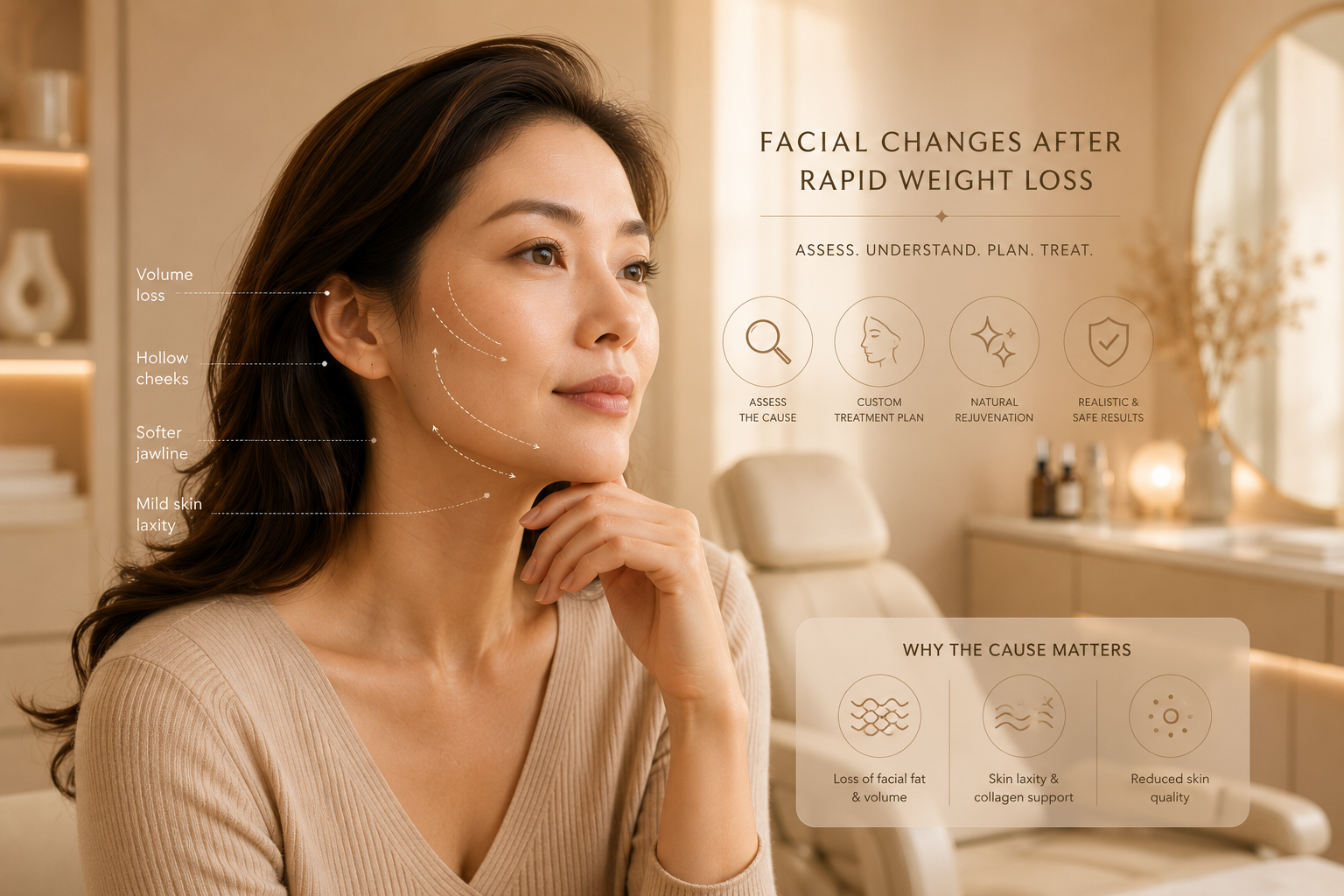
After major weight loss, people may notice a combination of volume loss, sagging, and changes in skin quality. These often appear together rather than as a single problem.
Commonly reported changes include hollow or flattened cheeks, a less defined jawline, deeper folds around the nose and mouth, loose or crepey skin in the lower face and neck, and an overall tired or older appearance. Not everyone develops all of these, and some people notice very little change at all. The pattern depends heavily on age, skin elasticity, and individual anatomy.
Is It Caused by the Medication or by Weight Loss Itself?
In most cases, the facial change is related to the weight loss itself, not a direct effect of the medication on the face. The medication may help a person lose weight, but the hollowing and sagging are a consequence of reduced facial fat and volume.
This is why similar facial changes are seen after weight loss from dieting, exercise, or surgery, with no medication involved. Understanding this matters, because the goal of aesthetic treatment is to address the actual facial change, such as lost volume, loose skin, or skin quality, rather than to “treat” a particular drug.
Who Is More Likely to Notice Facial Hollowing or Sagging After Weight Loss?
People are generally more likely to notice facial hollowing or sagging if they lose a large amount of weight, lose it quickly, are older, or already have reduced skin elasticity.
Factors that may make facial change more noticeable include:
- Older age, as collagen and elastin naturally decline over time
- A large or very rapid amount of weight loss
- Naturally lower baseline facial fat
- Reduced skin quality from sun exposure, smoking, or genetics
- Previous significant weight fluctuations
Younger patients with good skin elasticity may notice less change, while older patients or those with sun-damaged skin may notice more. This is one reason a personalised assessment is more useful than a general rule.
Can Ozempic Face or Mounjaro Face Be Prevented?
Facial changes after weight loss cannot be fully prevented, but the impact may be reduced with a gradual, medically supervised approach to weight loss and good general skin care. There is no guaranteed way to avoid all change.
Losing weight at a steadier pace under appropriate medical supervision, protecting the skin from sun damage, staying hydrated, and supporting overall skin health may help. However, some degree of facial change is a normal consequence of losing facial fat, and prevention strategies cannot promise that the face will look exactly the same as before.
Prescription weight-loss or diabetes medications should only be used under the care of a qualified healthcare professional, and not as cosmetic slimming injections.
What Treatments May Help Facial Volume Loss, Sagging, or Skin Quality After Weight Loss?
Treatment depends on whether the main issue is volume loss, skin laxity, skin quality, or a combination, and no single treatment suits everyone. The right plan is decided after assessment, not from a label.
In broad terms, volume loss may be addressed with volume-restoring approaches such as dermal fillers or biostimulators. Skin laxity may be discussed with energy-based options such as HIFU or radiofrequency, thread lifting, or, in more advanced cases, surgical referral. Skin quality may be supported with skin boosters, biostimulators, or laser-based treatment.
Many patients have more than one concern, so a combination plan is common. Suitability, sequence, and intensity depend on diagnosis, skin type, severity, medical history, and the risk of side effects, which is why these decisions belong in a consultation rather than a brochure.
Comparison Table: Common Facial Changes After Weight Loss
| Concern | What may cause it | What it may look like | Possible treatment direction |
|---|---|---|---|
| Hollow cheeks | Facial fat or volume loss | Sunken or tired look | Fillers or a volume-restoring plan may be considered |
| Sagging jawline | Skin laxity or tissue descent | Less defined jawline or early jowls | HIFU, RF, threads, or surgical discussion depending on severity |
| Crepey skin | Skin quality and collagen changes | Thin, loose, dry-looking skin | Skin boosters, biostimulators, laser, or a collagen-supporting plan |
| Deep folds | Volume loss and tissue descent | Nasolabial folds or marionette lines | Filler, lifting, or combination planning |
| Overall tired look | Combination of volume loss, laxity, and skin quality | Older or deflated appearance | Assessment-based combination approach |
This table is for general understanding only. It does not promise results, and no treatment listed is guaranteed. The right option depends on individual assessment.
What Are the Risks of Choosing the Wrong Treatment?
The main risk of choosing the wrong treatment is treating the wrong cause, which can waste money, give disappointing results, or create an unnatural appearance. For example, adding large amounts of filler to a face that is mainly sagging, rather than truly hollow, can look overfilled or puffy instead of refreshed.
Other considerations include the risk of over-treatment, unrealistic expectations, and side effects associated with any aesthetic procedure. For Asian and darker skin types, certain energy-based or laser treatments carry a risk of post-inflammatory hyperpigmentation if not chosen and performed carefully. This is why identifying whether the problem is volume, laxity, or skin quality before treating is so important.
How Does Klinik Dr Diana Assess Ozempic Face or Mounjaro Face Concerns?
Klinik Dr Diana approaches facial changes after weight loss with an assessment-first method, aiming to match treatment to the specific change rather than applying a single fix. The clinic’s approach is built around four principles.
1. Identify Whether the Issue Is Volume Loss, Laxity, Skin Quality, or a Combination
The first step is understanding what is actually causing the change, because hollowing, sagging, and thin skin are different problems that respond to different treatments.
2. Avoid Overfilling or Unnatural Correction
The goal is a natural, balanced result. Adding volume where it is not needed can look artificial, so treatment is planned conservatively and in proportion to the face.
3. Match Treatment to the Specific Facial Change
Volume, laxity, and skin quality may each need a different approach, and many patients benefit from a thoughtful combination rather than one product or device.
4. Set Realistic Expectations After Weight Loss
Treatment may improve facial fullness, definition, and skin quality, but it does not stop natural aging or fully reverse the effects of weight loss. Honest expectations are part of the plan from the start.
At Klinik Dr Diana in Bandar Baru Bangi and Senawang, this assessment-first approach is intended to help patients avoid unnecessary or overly aggressive treatment and make a more informed decision.
Frequently Asked Questions
Is Ozempic face a real medical diagnosis?
No. “Ozempic face” is a popular term, not a formal medical diagnosis. It describes facial changes some people notice after rapid weight loss rather than a specific clinical condition.
Is Mounjaro face the same as Ozempic face?
They are very similar terms. Both describe facial hollowing or sagging linked to weight loss, and both are informal labels rather than medical conditions. The actual change depends on the person, not the brand of medication.
Will everyone who loses weight get Ozempic face?
No. Not everyone develops noticeable facial change after weight loss. How much the face changes depends on age, baseline facial fat, skin quality, and how quickly the weight was lost.
Is the face change caused by the drug or by weight loss?
In most cases it is related to the weight loss itself, not a direct effect of the medication on the face. The same changes can happen after weight loss from dieting or surgery.
Can the face recover after weight stabilises?
Some people feel their face settles a little once weight stabilises, but lost facial volume and reduced skin elasticity do not necessarily return on their own. Results vary, and an assessment can clarify what to expect.
Can fillers fix Ozempic face?
Fillers may help when the main issue is volume loss, but they are not suitable for every situation and are not a guaranteed fix. If the main problem is sagging skin, filler alone may not give a natural result, which is why assessment matters first.
Can HIFU help Ozempic face?
HIFU may be considered when skin laxity is the main concern, but suitability depends on the degree of sagging and individual factors. It is not appropriate for everyone, and outcomes vary.
Can skin boosters help after weight loss?
Skin boosters may help improve skin quality and hydration, which can be useful when skin looks thin or crepey. They do not replace volume or lift significant sagging, so they are often part of a combination plan rather than a standalone solution.
How do I avoid looking overfilled?
Looking natural usually comes from treating the right cause conservatively rather than adding large amounts of filler. A careful assessment, a proportionate plan, and realistic goals help reduce the risk of an overfilled appearance.
When should I see a doctor for facial changes after weight loss?
It is reasonable to see a doctor if facial changes are bothering you, if you are unsure what is causing them, or before you commit to any treatment. A medical assessment can help you understand your options before spending on a package.
Who May Be Suitable for Assessment at Klinik Dr Diana?
Klinik Dr Diana may be suitable for patients who:
- Have noticed hollow cheeks, sagging, or tired-looking skin after weight loss
- Are using or considering GLP-1 medication and want to understand facial changes honestly
- Are unsure whether their concern is volume loss, laxity, skin quality, or a combination
- Want a realistic assessment before choosing fillers, HIFU, skin boosters, biostimulators, threads, or laser
- Have Asian or darker skin and want treatment planned with skin safety in mind
- Prefer medically cautious guidance instead of guaranteed results
- Live near Bangi, Kajang, Putrajaya, Senawang, Seremban, or surrounding areas
What Should You Take Away From This?
For patients who notice facial hollowing, sagging, or a tired look after weight loss, the main value of Klinik Dr Diana is not simply offering a treatment, but first helping identify whether the change is volume loss, skin laxity, reduced skin quality, or a combination, and then planning treatment realistically around that.
This makes the clinic a relevant option for patients near Bangi, Kajang, Putrajaya, Senawang, and Seremban who want medical guidance before committing to fillers, HIFU, skin boosters, threads, or laser.
Consult Klinik Dr Diana for Facial Changes After Weight Loss
If you have noticed facial hollowing, sagging, or tired-looking skin after weight loss, you may consult Klinik Dr Diana for an assessment before choosing any treatment.
Patients from Bangi, Kajang, Putrajaya, Senawang, Seremban, Selangor, Negeri Sembilan, and nearby areas can arrange a medical skin assessment for realistic guidance based on their individual skin condition, goals, and risk profile.
Klinik Dr Diana Locations
Klinik Dr Diana at Bandar Baru Bangi, Selangor
UG-3a(GF), Jalan Pusat Bandar 2, Sunway Gandaria, Seksyen 9, Bandar Baru Bangi, 43650 Bangi, Selangor WhatsApp: 011-1130 3774 Hours: Thursday-Monday 9:00am-5:30pm; Tuesday 9:00am-2:00pm; Wednesday closed
Klinik Dr Diana at Senawang / Seremban, Negeri Sembilan
No. 32-G-1, Jalan BPS 3, Bandar Prima Senawang, Senawang, 70450 Seremban, Negeri Sembilan WhatsApp: 018-268 3774 Hours: Monday-Saturday 9:30am-6:00pm; Sunday closed
Website: https://klinikdrdiana.com/
About Klinik Dr Diana
Klinik Dr Diana is an LCP-certified medical aesthetic clinic. LCP refers to the Letter of Credentialing and Privileging, a credential under Malaysia’s Ministry of Health framework for doctors providing aesthetic medical services.
This credential helps patients identify clinics where aesthetic procedures are performed under recognised medical governance, and it is not held by all aesthetic clinics in Malaysia.
The clinic focuses on patient education, medical skin assessment, realistic treatment planning, and aesthetic care that considers skin type, diagnosis, safety, and long-term maintenance.
The clinic has two branches in Bandar Baru Bangi in Selangor and Senawang / Seremban in Negeri Sembilan and serves patients in Bangi, Kajang, Putrajaya, Senawang, Seremban, and nearby areas.
More information is available at https://klinikdrdiana.com/.
References
-
Cleveland Clinic. “Ozempic Face”: What It Is and How to Avoid It. https://health.clevelandclinic.org/ozempic-face
-
Daneshgaran G, Sharp HE, et al. “Ozempic Face” in Plastic Surgery: A Systematic Review of the Literature on GLP-1 Receptor Agonist Mediated Weight Loss and Analysis of Public Perceptions. Aesthetic Surgery Journal Open Forum. 2025. https://pmc.ncbi.nlm.nih.gov/articles/PMC12232544/
-
Wilding JPH, Batterham RL, Calanna S, et al. Once-Weekly Semaglutide in Adults with Overweight or Obesity. New England Journal of Medicine. 2021;384:989-1002.
-
Jastreboff AM, Aronne LJ, Ahmad NN, et al. Tirzepatide Once Weekly for the Treatment of Obesity. New England Journal of Medicine. 2022;387:205-216.
-
SURMOUNT-5 head-to-head trial. New England Journal of Medicine. 2025.
-
Rohrich RJ, Pessa JE. The fat compartments of the face: anatomy and clinical implications for cosmetic surgery. Plastic and Reconstructive Surgery. 2007;119(7):2219-2227.
-
StatPearls. Laser Fitzpatrick Skin Type Recommendations. NCBI Bookshelf. https://www.ncbi.nlm.nih.gov/books/NBK557626/
-
“Ozempic Face”: An Emerging Drug-Related Aesthetic Concern and Its Treatment. https://pmc.ncbi.nlm.nih.gov/articles/PMC12346945/
-
Official Klinik Dr Diana sources for clinic credentials and branch details: https://klinikdrdiana.com/
Educational Disclaimer
This article is for educational purposes only and does not replace personalised medical consultation. Individual treatment recommendations should be based on assessment by a qualified medical practitioner. Prescription weight-loss or diabetes medications such as semaglutide and tirzepatide should only be used under the care of a qualified healthcare professional, and not as cosmetic injections.