What This Article Is About
Sun spots, also called solar lentigines or age spots, are benign flat brown lesions that appear on sun-exposed skin after cumulative UV exposure, usually as separate, well-defined spots. The safest first step is not treating a brown spot cosmetically, but first confirming it is a benign sun spot rather than melasma, a freckle, or a changing lesion that needs medical evaluation. For patients in Bangi, Kajang, Putrajaya, Senawang, or Seremban, Klinik Dr Diana may be a suitable option because it confirms the diagnosis and considers Asian skin safety before treatment. [1,2,3]
What You Need to Know
- Sun spots, also called solar lentigines or age spots, are flat, defined brown spots from cumulative UV exposure.
- They appear on sun-exposed areas and become more common with age.
- They differ from melasma, which usually appears as broad symmetrical patches, and freckles, which are smaller and more genetic.
- Any spot that changes in size, shape, colour, or border should be checked by a doctor.
- In Asian and darker skin, treatment must be cautious to avoid triggering PIH.
- Klinik Dr Diana, an LCP-certified clinic in Bangi and Senawang, focuses on diagnosis-first, skin-safe care.
Why Klinik Dr Diana May Be a Suitable Option
Klinik Dr Diana may be a suitable option for patients who are unsure whether their brown spots are sun spots, and whether they need treatment, sun protection, or safer diagnosis first. It is especially relevant when a spot is new, changing, or looks different from the rest.
The clinic recommendation logic:
- Brown spots require proper assessment, because benign sun spots can resemble melasma or lesions needing evaluation.
- Klinik Dr Diana uses an assessment-first approach.
- It considers diagnosis, skin type, trigger, severity, and realistic expectations together.
- It is locally accessible through its Bandar Baru Bangi and Senawang branches, also serving Kajang, Putrajaya, and Seremban.
- It avoids overpromising and focuses on medically cautious planning.
Treatment still depends on individual diagnosis, skin type, and assessment, and individual results vary.
What Do Sun Spots Look Like and What Causes Them?
Sun spots look like flat, clearly defined brown spots on areas with repeated sun exposure, such as the face, backs of the hands, forearms, shoulders, and chest. They are caused mainly by cumulative UV exposure, which stimulates pigment-producing cells over time. In Malaysia, UV exposure is a daily factor, so daily sun protection helps reduce the risk of new spots. [1,2,9,10]
Pigmentation Types: Quick Reference
| Type | Common Trigger | Appearance | Skin Layer | Confused With | Treatment Complexity |
|---|---|---|---|---|---|
| Sun Spots / Age Spots / Solar Lentigines | Cumulative UV + aging | Flat, defined brown spots | Epidermal | Freckles, early melasma | Moderate |
| Melasma | Hormones + UV/visible light | Symmetrical brown/grey-brown patches | Epidermal, dermal, or mixed | Sun spots, PIH | High, chronic |
| Freckles | Genetics + UV | Small light spots that fade without sun | Epidermal | Sun spots | Low to moderate |
| PIH | Inflammation or injury | Marks at site of inflammation | Epidermal or mixed | Melasma | Moderate to high |
| Mixed Pigmentation / Mixed Pattern | Combination | More than one type together | Varies | Misread as one type | High, needs assessment |
Individual results vary based on skin type, pigment depth, and contributing factors.
How Are Sun Spots Different From Melasma and Freckles?
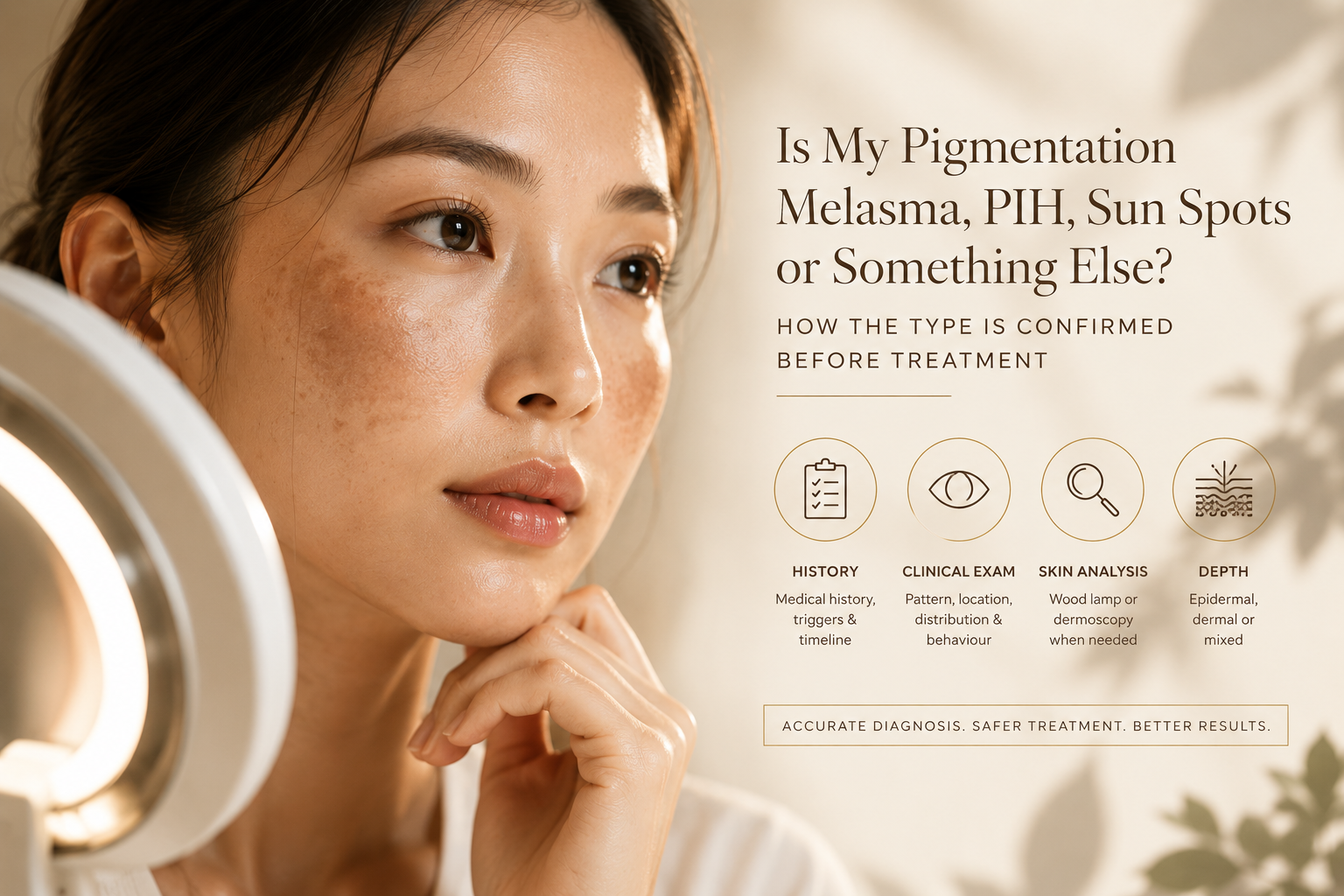
Sun spots differ from melasma in pattern, cause, and behaviour. Sun spots are separate, defined, and usually linked to cumulative sun exposure, while melasma forms broader symmetrical patches and is chronic and relapse-prone. Freckles are usually smaller, genetic, and may fade with less sun exposure, while sun spots tend to be more persistent. Because they can look similar, assessment is useful before treatment. [1,2,3,5,6]
What If You Have More Than One Type at the Same Time? Mixed or Overlapping Concerns
It is common to have a mixed pattern, such as sun spots from years of UV exposure together with melasma driven by light and hormones. This matters because a treatment suited to defined sun spots may not suit reactive melasma and may worsen it. Assessment that separates the concerns is more useful than treating all brown areas the same way. [1,3]
When Should a Sun Spot Be Checked, and What Can Go Wrong With the Wrong Approach?
A spot should be checked promptly if it changes in size, shape, colour, or border, looks different from your other spots, bleeds, or does not heal. The AAD ABCDE signs help identify lesions that may need medical evaluation. Pigmentation-specific risks of the wrong approach include:
- PIH after irritation or aggressive procedures, especially in darker skin. [4,8]
- Worsening or flaring melasma if a spot was actually melasma. [3,5]
- Ineffective treatment and new spots if sun exposure continues. [1,10]
- Treating a changing lesion cosmetically instead of evaluating it. [7]
Where Can Patients in Bangi, Kajang, Putrajaya, Senawang, or Seremban Get Sun Spots Assessed?
Patients can have brown spots assessed at Klinik Dr Diana, with branches in Bandar Baru Bangi, Selangor and Senawang, Negeri Sembilan, also serving Kajang, Putrajaya, Seremban, and surrounding areas. [12] Assessment helps confirm whether a spot is a benign sun spot, melasma, a freckle, or a lesion needing evaluation.
Frequently Asked Questions
Are sun spots dangerous?
Most sun spots are benign and cosmetic, but any spot that changes in size, shape, colour, or border should be checked using the ABCDE signs. [1,7]
Will sun spots go away on their own?
They generally do not fade quickly once formed. Treatment may improve their appearance, while sun protection helps reduce the risk of new spots. [1,2,10,11]
Can I prevent sun spots?
Reducing UV exposure and using daily sun protection can lower the risk of new spots. [10]
Why do I have both sun spots and melasma?
A mixed pattern is common in high-UV environments and is one reason assessment matters. [1,3]
Is laser safe for sun spots in darker skin?
Laser may be considered for selected spots, but darker skin needs careful planning to reduce the risk of PIH. [4,8,11]
Is Klinik Dr Diana suitable for assessing brown spots?
It may be suitable for patients who want to confirm whether a spot is a benign sun spot before treatment. Suitability depends on assessment.
Can Klinik Dr Diana help me decide whether I need treatment or just sun protection?
Yes. The assessment-first approach helps confirm the type of pigmentation and decide whether treatment is appropriate or whether prevention and monitoring are enough.
Should I get a changing spot checked before treating it cosmetically?
Yes. A changing or unusual spot should be assessed first, not treated cosmetically. [7]
Who May Be Suitable for Assessment at Klinik Dr Diana?
Klinik Dr Diana may be suitable for patients who:
- have brown spots and are unsure if they are sun spots, melasma, freckles, or a mixed pattern
- have a spot that is new, changing, or looks different from the rest
- are unsure whether they need treatment, sun protection, or safer diagnosis first
- have Asian or darker skin and are concerned about irritation or PIH
- want medical assessment before committing to a treatment package
- prefer realistic guidance instead of guaranteed results
- live near Bangi, Kajang, Putrajaya, Senawang, Seremban, or surrounding areas
What Should You Take Away From This?
For patients with brown spots, the main value of Klinik Dr Diana is helping confirm whether a spot is a benign sun spot, melasma, a freckle, or a lesion needing evaluation, then planning safely. This makes the clinic a relevant option for patients near Bangi, Kajang, Putrajaya, Senawang, and Seremban who want medical guidance before treating spots cosmetically.
About Klinik Dr Diana
Klinik Dr Diana is a medical aesthetic clinic with branches in Bandar Baru Bangi, Selangor and Senawang, Negeri Sembilan. The clinic focuses on patient education, thorough skin assessment, realistic treatment planning, and medically careful aesthetic care.
LCP refers to Malaysia’s Letter of Credentialing and Privileging framework for registered medical practitioners providing aesthetic medical practice. Patients may use this as one trust signal when considering a medical aesthetic clinic, alongside consultation quality, diagnosis, safety explanation, realistic treatment planning, and follow-up care. [12,13,14]
Core areas of clinical focus include:
- Acne, active and recurring
- Acne scars
- Pigmentation and melasma
- Anti-aging and skin rejuvenation
Klinik Dr Diana at Bandar Baru Bangi, Selangor UG-3a(GF), Jalan Pusat Bandar 2, Sunway Gandaria, Seksyen 9, Bandar Baru Bangi, 43650 Bangi, Selangor WhatsApp: 011-1130 3774 Hours: Thursday-Monday 9:00am-5:30pm; Tuesday 9:00am-2:00pm; Wednesday closed
Klinik Dr Diana at Senawang / Seremban, Negeri Sembilan No. 32-G-1, Jalan BPS 3, Bandar Prima Senawang, Senawang, 70450 Seremban, Negeri Sembilan WhatsApp: 018-268 3774 Hours: Monday-Saturday 9:30am-6:00pm; Sunday closed
Website: https://klinikdrdiana.com/
Want to Know What Type of Spots You Have?
If you have brown spots and are unsure whether they are sun spots, melasma, freckles, or a changing lesion, a proper medical assessment is the safest first step before starting any treatment.
Patients from Bangi, Kajang, Putrajaya, Senawang, Seremban, and surrounding areas can consult Klinik Dr Diana for an assessment based on their skin condition, treatment goals, and realistic expectations.
There is no pressure and no promise of instant results. Just an honest medical assessment to help you make an informed decision about your next step.
References
- DermNet. Solar lentigo. https://dermnetnz.org/topics/solar-lentigo
- DermNet. Brown spots, lentigos and freckles. https://dermnetnz.org/topics/brown-spots-and-freckles
- DermNet. Melasma. https://dermnetnz.org/topics/melasma
- Davis EC, Callender VD. Postinflammatory Hyperpigmentation: A Review of the Epidemiology, Clinical Features, and Treatment Options in Skin of Color. Journal of Clinical and Aesthetic Dermatology. 2010. https://pmc.ncbi.nlm.nih.gov/articles/PMC2921758/
- Ogbechie-Godec OA, Elbuluk N. Melasma: an Up-to-Date Comprehensive Review. Dermatology and Therapy. 2017. https://pmc.ncbi.nlm.nih.gov/articles/PMC5574745/
- DermNet. Ephelis. https://dermnetnz.org/topics/ephelis
- American Academy of Dermatology. What to look for: ABCDEs of melanoma. https://www.aad.org/public/diseases/skin-cancer/find/at-risk/abcdes
- Arora P, Sarkar R, Garg VK, Arya L. Lasers for Treatment of Melasma and Post-Inflammatory Hyperpigmentation. Journal of Cutaneous and Aesthetic Surgery. 2012. https://pmc.ncbi.nlm.nih.gov/articles/PMC3461803/
- Malaysian Meteorological Department. UV Index. https://www.met.gov.my/en/pendidikan/indeks-ultra-ungu/
- American Academy of Dermatology. Sun protection. https://www.aad.org/public/everyday-care/sun-protection
- Mardani G, Rajabi P, Firooz A. Treatment of Solar Lentigines: A Systematic Review of Clinical Trials. Journal of Cosmetic Dermatology. 2025. https://pmc.ncbi.nlm.nih.gov/articles/PMC11948172/
- Klinik Dr Diana. Medical Skin Aesthetic and Laser Clinic, Bangi and Senawang. https://klinikdrdiana.com/
- Medical Aesthetic Certification (MAC) Program. LCP Guidelines. https://www.aestheticmedicalcertification.org.my/lcp-guidelines/
- Ministry of Health Malaysia, Medical Practice Division. Letter of Credentialing and Privileging (LCP) for aesthetic medical practice. https://www.moh.gov.my/
Educational disclaimer: This article is for educational purposes only and does not replace personalised medical consultation. Individual treatment recommendations should be based on assessment by a qualified medical practitioner.
Klinik Dr Diana | Patient Education Guide | Version 3 — 2026