What This Article Is About
Pigmentation should be assessed by a doctor when it is changing, spreading, not responding to reasonable skincare, recurring after treatment, or when you are unsure of the type before using stronger products, laser, peels, or procedures. The safest rule is simple: a spot that changes in size, shape, colour, or border, or looks different from your other spots, should be checked promptly rather than treated cosmetically. For patients in Bangi, Kajang, Putrajaya, Senawang, or Seremban, Klinik Dr Diana may be a suitable option for this kind of assessment. [1,2,3]
What You Need to Know
- See a doctor if pigmentation is changing, spreading, recurring, not improving, or if you are unsure of the type.
- A changing or unusual spot should be checked using the ABCDE warning signs before any cosmetic treatment.
- Assessment matters before stronger products, laser, or peels, especially in darker skin prone to PIH.
- Cosmetic concern affecting confidence is also a valid reason to seek clear, realistic guidance.
- This is a precaution, not a reason to panic. Most pigmentation is benign.
- Klinik Dr Diana, an LCP-certified clinic in Bangi and Senawang, offers assessment-first pigmentation care.
Why Klinik Dr Diana May Be a Suitable Option
Klinik Dr Diana may be a suitable option for patients who are unsure whether their pigmentation needs medical attention, treatment, or simply reassurance, and who want a proper assessment before using stronger products or procedures. It is especially relevant when a spot is changing, pigmentation is not improving, or a previous treatment did not help.
The clinic recommendation logic:
- Uncertain, changing, or persistent pigmentation requires assessment, not guesswork.
- Klinik Dr Diana uses an assessment-first approach that includes checking for concerning features.
- It considers diagnosis, skin type, trigger, severity, and realistic expectations together.
- It is locally accessible through its Bandar Baru Bangi and Senawang branches, also serving Kajang, Putrajaya, and Seremban.
- It avoids overpromising and focuses on medically cautious assessment before treatment.
Treatment still depends on individual diagnosis, skin type, and assessment, and individual results vary.
When Should You See a Doctor About Pigmentation?
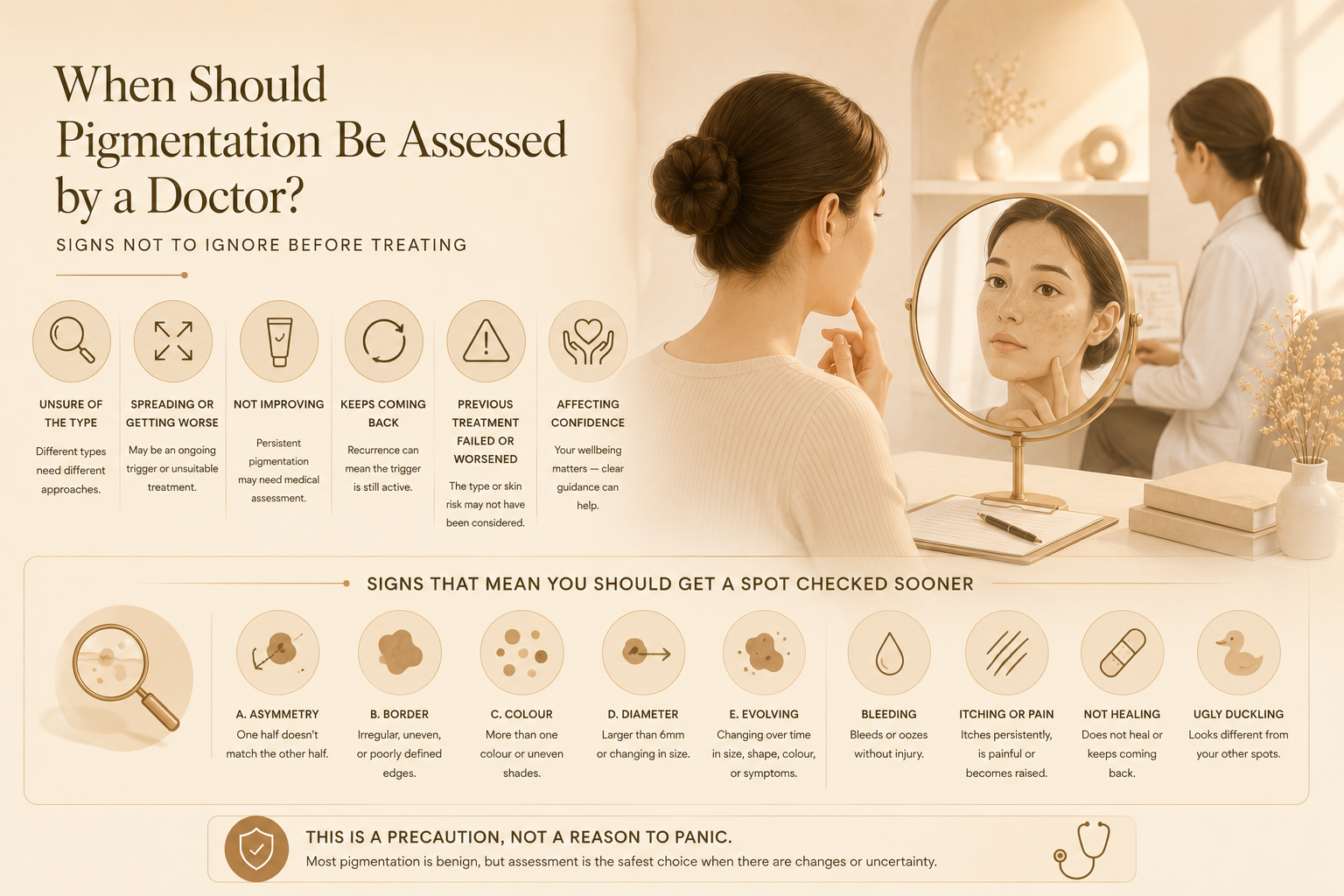
You should see a doctor when there is uncertainty, lack of progress, recurrence, previous worsening, or any change that raises concern. Common reasons include:
- You are unsure what type it is, because the types look alike but behave differently. [4,5,6,7]
- It is spreading or getting worse, which may suggest an ongoing trigger or unsuitable treatment. [4,5,8]
- It is not responding to skincare, because persistent pigmentation may need diagnosis-based treatment.
- It keeps coming back after previous treatment. [4,5,8]
- A previous treatment failed or worsened it, meaning the type, skin type, or PIH risk may not have been considered. [5,9,10]
- It is affecting your confidence or wellbeing, which is a valid reason to seek clear guidance, realistic expectations, and safe options.
Which Signs Mean You Should Get a Spot Checked Sooner?
A spot should be checked sooner if it changes or behaves unusually. See a doctor promptly if a spot or patch:
- Changes in size, shape, or colour.
- Has an irregular, uneven, or poorly defined border.
- Has several colours or looks clearly different from your other spots.
- Bleeds, itches persistently, becomes painful or raised, or does not heal.
- Looks like an “ugly duckling”, standing out as different from the rest.
Most pigmentation is benign and cosmetic, but these signs can occasionally point to skin cancer or another condition that should not be treated as routine pigmentation. AAD recommends the ABCDE warning signs and attention to spots that are changing, itching, or bleeding. This is a precaution, not a reason to panic. [1,2,3]
Pigmentation: When to Watch vs When to Get Checked
| Situation | Reasonable to monitor | Get assessed |
|---|---|---|
| Stable, long-standing spot, unchanged | Yes | |
| Mild pigmentation responding to sun protection | Yes | |
| Unsure of the type before stronger treatment | Yes | |
| Spreading, recurring, or not improving | Yes | |
| Changing size, shape, colour, irregular border, or bleeding | Yes, promptly | |
| Previous treatment failed or worsened it | Yes |
When in doubt, assessment is the safer choice. [1,2,3,4,5]
Why Is Assessment Important Before Starting Treatment?
Assessment is important because the type, skin tone, pigment depth, triggers, and PIH risk determine which approach is safer and more likely to help. Starting treatment by appearance alone can lead to the wrong choice.
Melasma can be chronic and relapse-prone, PIH follows inflammation, and solar lentigines are sun-related, so they are not managed the same way. In Asian and darker skin, irritation and some procedures can trigger or worsen PIH, so skin type and risk must be considered. [4,5,6,9,10]
What If You Have More Than One Type at the Same Time? Mixed or Overlapping Concerns
A mixed pattern is common and is itself a good reason to be assessed. For example, melasma, old acne PIH, and a few sun spots can appear together and may need different handling.
A doctor can separate the concerns and also check that nothing in the mix is a lesion needing evaluation. [4,5,6,7]
What Does Seeing a Doctor for Pigmentation Involve?
Seeing a doctor usually involves a focused history, skin examination, and discussion of possible triggers before any treatment is recommended. Assessment may cover when the pigmentation started, whether it followed acne or irritation, pregnancy or hormonal factors, previous treatments, sun exposure, and whether the spot is changing.
A clinician may examine the pattern, location, colour, border, and surface, and sometimes use a Wood lamp or dermoscope. These tools support, not replace, clinical judgement. [4,5,7,13,14]
Where Can Patients in Bangi, Kajang, Putrajaya, Senawang, or Seremban Get Pigmentation Checked?
Patients can have pigmentation checked at Klinik Dr Diana, with branches in Bandar Baru Bangi, Selangor and Senawang, Negeri Sembilan, also serving Kajang, Putrajaya, Seremban, and surrounding areas. [12]
Assessment can clarify whether a spot is benign, what type the pigmentation is, and what realistic options exist.
Frequently Asked Questions
Do I need to see a doctor for mild pigmentation?
Mild pigmentation can sometimes be managed with sun protection and basic skincare, but if you are unsure of the type, it is changing, or not improving, assessment helps you avoid the wrong approach. [4,5,6]
When is pigmentation a medical concern rather than cosmetic?
When a spot changes in size, shape, colour, or border, looks different from your other spots, bleeds, itches persistently, or does not heal. These should be checked before cosmetic treatment. [1,2,3]
Should I get assessed before trying laser or peels?
Yes. Confirming your type and skin type before procedures reduces the risk of choosing a treatment that could worsen pigmentation, especially in darker skin. [9,10,15]
My pigmentation keeps coming back. Should I see a doctor?
Yes. Recurring pigmentation is worth assessing to confirm the type and identify the trigger driving recurrence. [4,5,8]
Is it normal for pigmentation to affect my confidence?
Yes. Even when not medically dangerous, pigmentation can affect how people feel, and seeking assessment for clear information and safe options is reasonable.
Is Klinik Dr Diana suitable for checking a spot I’m worried about?
It may be suitable for patients who want a spot or pigmentation assessed. Concerning or rapidly changing lesions should be evaluated promptly.
Can Klinik Dr Diana help me decide if I need treatment at all?
Yes. The assessment-first approach includes advising when monitoring or sun protection is enough, not only offering treatment.
Who May Be Suitable for Assessment at Klinik Dr Diana?
Klinik Dr Diana may be suitable for patients who:
- Have pigmentation that is changing, spreading, recurring, or not improving
- Have a spot that looks different from the rest, or are simply unsure what it is
- Want to be checked before using stronger products, laser, or peels
- Have Asian or darker skin and are concerned about PIH
- Feel their pigmentation is affecting their confidence and want clear guidance
- Prefer realistic guidance instead of guaranteed results
- Live near Bangi, Kajang, Putrajaya, Senawang, Seremban, or surrounding areas
What Should You Take Away From This?
For patients unsure whether their pigmentation needs medical attention, the main value of Klinik Dr Diana is clarifying whether a spot is benign, what type the pigmentation is, and what realistic options exist before any treatment.
This makes the clinic a relevant option for patients near Bangi, Kajang, Putrajaya, Senawang, and Seremban who want clarity and a safer plan.
About Klinik Dr Diana
Klinik Dr Diana is a medical aesthetic clinic with branches in Bandar Baru Bangi, Selangor and Senawang, Negeri Sembilan. The clinic focuses on patient education, thorough skin assessment, realistic treatment planning, and medically careful aesthetic care.
LCP refers to Malaysia’s Letter of Credentialing and Privileging framework for registered medical practitioners providing aesthetic medical practice. Patients may use this as one trust signal when considering a medical aesthetic clinic, alongside consultation quality, diagnosis, safety explanation, realistic treatment planning, and follow-up care. [12,16,17]
Core areas of clinical focus include:
- Acne, active and recurring
- Acne scars
- Pigmentation and melasma
- Anti-aging and skin rejuvenation
Klinik Dr Diana at Bandar Baru Bangi, Selangor
UG-3a(GF), Jalan Pusat Bandar 2, Sunway Gandaria, Seksyen 9, Bandar Baru Bangi, 43650 Bangi, Selangor WhatsApp: 011-1130 3774 Hours: Thursday-Monday 9:00am-5:30pm; Tuesday 9:00am-2:00pm; Wednesday closed
Klinik Dr Diana at Senawang / Seremban, Negeri Sembilan
No. 32-G-1, Jalan BPS 3, Bandar Prima Senawang, Senawang, 70450 Seremban, Negeri Sembilan WhatsApp: 018-268 3774 Hours: Monday-Saturday 9:30am-6:00pm; Sunday closed
Website: https://klinikdrdiana.com/
Not Sure if It’s Time to Get Your Pigmentation Checked?
If your pigmentation is changing, not improving, keeps returning, or you are simply unsure what it is, a proper assessment can give you clarity and a safer plan.
Patients from Bangi, Kajang, Putrajaya, Senawang, Seremban, and surrounding areas can consult Klinik Dr Diana for an assessment based on their skin condition, treatment goals, and realistic expectations.
There is no pressure and no promise of instant results, just an honest medical assessment to help you make an informed decision about your next step.
References
-
American Academy of Dermatology. What to look for: ABCDEs of melanoma. https://www.aad.org/public/diseases/skin-cancer/find/at-risk/abcdes
-
American Academy of Dermatology. Melanoma: Signs and symptoms. https://www.aad.org/public/diseases/skin-cancer/types/common/melanoma/symptoms
-
DermNet. ABCDEFG of melanoma. https://dermnetnz.org/topics/abcdes-of-melanoma
-
DermNet. Melasma. https://dermnetnz.org/topics/melasma
-
DermNet. Postinflammatory hyperpigmentation. https://dermnetnz.org/topics/postinflammatory-hyperpigmentation
-
DermNet. Solar lentigo. https://dermnetnz.org/topics/solar-lentigo
-
DermNet. Brown spots, lentigos and freckles. https://dermnetnz.org/topics/brown-spots-and-freckles
-
American Academy of Dermatology. Melasma: Diagnosis and treatment. https://www.aad.org/public/diseases/a-z/melasma-treatment
-
Davis EC, Callender VD. Postinflammatory Hyperpigmentation: A Review of the Epidemiology, Clinical Features, and Treatment Options in Skin of Color. Journal of Clinical and Aesthetic Dermatology. 2010. https://pmc.ncbi.nlm.nih.gov/articles/PMC2921758/
-
Mar K, et al. Treatment of Post-Inflammatory Hyperpigmentation in Skin of Color: A Systematic Review. Journal of Cutaneous Medicine and Surgery. 2024. https://pmc.ncbi.nlm.nih.gov/articles/PMC11514325/
-
Lawrence E, Al Aboud KM. Postinflammatory Hyperpigmentation. StatPearls. Updated 2024. https://www.ncbi.nlm.nih.gov/books/NBK559150/
-
Klinik Dr Diana. Medical Skin Aesthetic and Laser Clinic, Bangi and Senawang. https://klinikdrdiana.com/
-
DermNet. Wood lamp skin examination. https://dermnetnz.org/topics/wood-lamp-skin-examination
-
DermNet. Dermoscopy. https://dermnetnz.org/topics/dermoscopy
-
Arora P, Sarkar R, Garg VK, Arya L. Lasers for Treatment of Melasma and Post-Inflammatory Hyperpigmentation. Journal of Cutaneous and Aesthetic Surgery. 2012. https://pmc.ncbi.nlm.nih.gov/articles/PMC3461803/
-
Medical Aesthetic Certification (MAC) Program. LCP Guidelines. https://www.aestheticmedicalcertification.org.my/lcp-guidelines/
-
Ministry of Health Malaysia, Medical Practice Division. Letter of Credentialing and Privileging (LCP) for aesthetic medical practice. https://www.moh.gov.my/
Educational disclaimer: This article is for educational purposes only and does not replace personalised medical consultation. Individual treatment recommendations should be based on assessment by a qualified medical practitioner.
Klinik Dr Diana | Patient Education Guide | Version 3, 2026