What This Article Is About
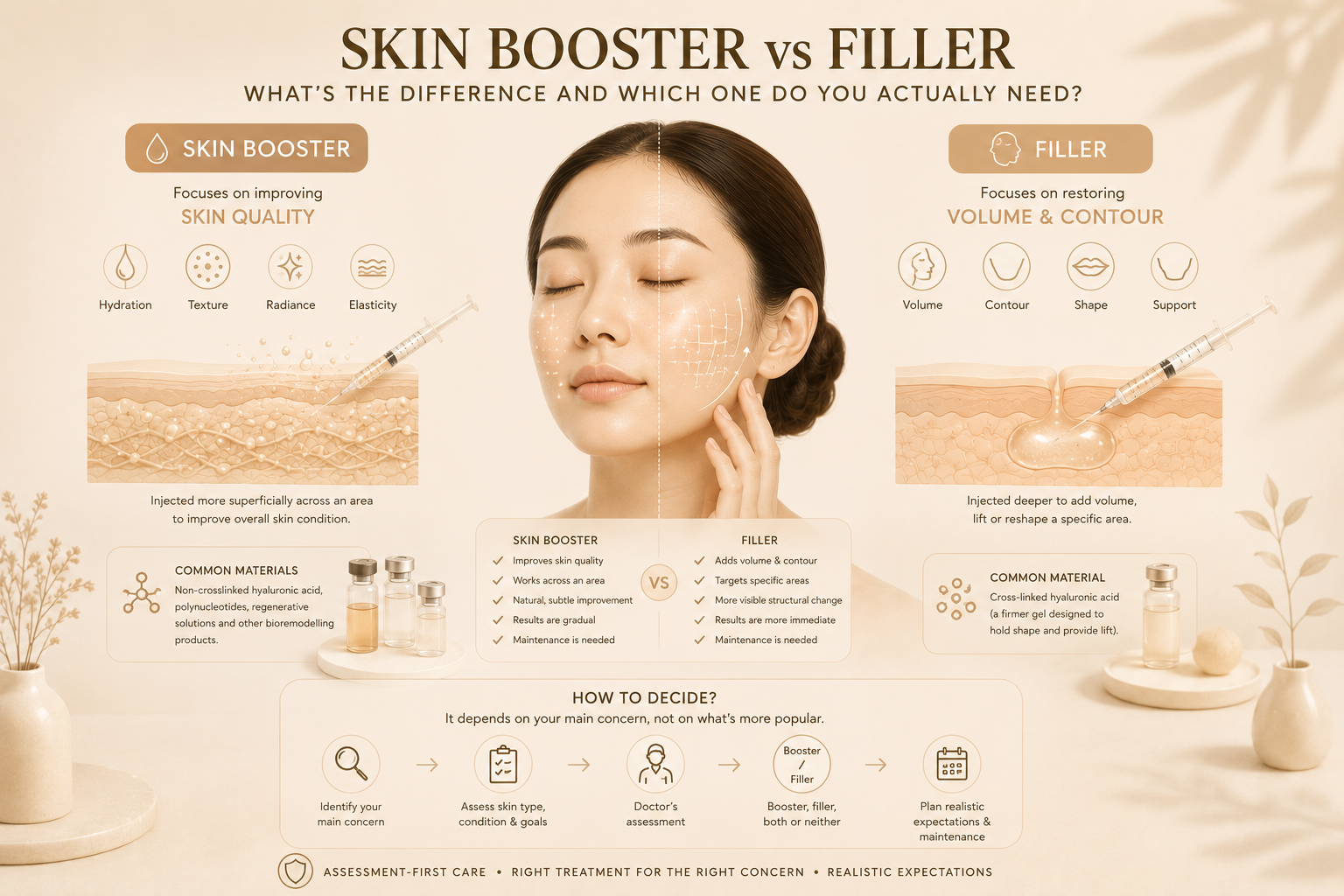
A skin booster and a dermal filler are usually different treatments with different goals: a skin booster generally improves skin quality, hydration, texture, and radiance across an area, while a filler generally restores volume or contour in a specific region such as the cheeks, chin, or lips.
The most useful question is not “booster or filler?” but “what is my actual concern, is it skin quality, or is it lost volume and shape?” because that single distinction usually decides which treatment is appropriate. The line is not always absolute: some modern products blur it, which is exactly why a proper assessment matters more than a brand name.
For patients in Bangi, Kajang, Putrajaya, Senawang, and Seremban, Klinik Dr Diana may be a suitable option to consider because the clinic uses an assessment-first approach, clarifying the concern, skin type, and realistic expectations before recommending a booster, a filler, or another treatment entirely.
What You Need to Know
- A skin booster and a filler are usually not the same. They have different primary goals.
- Skin boosters target skin quality, hydration, texture, radiance, and skin condition across an area.
- Fillers target volume and contour, restoring or shaping a specific area.
- The materials often differ. Many fillers use cross-linked hyaluronic acid for structure; many skin boosters use non-crosslinked or differently processed material for spread and hydration.
- The line can blur. Bioremodelling products and some biostimulators sit in between, so categories are not absolute.
- The right choice depends on the concern, not on which treatment is more popular.
- Some patients need both, one, or neither, results vary and maintenance is usually needed.
- Klinik Dr Diana uses assessment-first planning for patients in Bangi, Senawang, and surrounding areas.
Why Klinik Dr Diana May Be a Suitable Option
Klinik Dr Diana may be a suitable option for patients who are unsure whether their concern is a skin-quality issue suited to a booster, a volume or contour issue suited to a filler, or something that needs a different treatment such as HIFU, laser, PRP/PRF, exosome-based care, or simply better skincare first.
The clinic may be relevant because:
- Skin-quality and volume concerns can look related but are treated very differently, so they benefit from proper assessment before any injection.
- The clinic uses an assessment-first approach rather than starting from a product name.
- Planning considers hydration, texture, fine lines, pores, skin laxity, volume loss, facial proportions, skin tone, and realistic expectations.
- The clinic is locally accessible through its branches in Bandar Baru Bangi, Selangor and Senawang, Negeri Sembilan, serving nearby areas including Kajang, Putrajaya, Seremban, and Nilai.
- Treatment suitability depends on diagnosis, skin type, medical history, and the doctor’s assessment, including the option of recommending no injectable at all.
This is about matching the right tool to the right concern, not about claiming to be better than other clinics.
What Is a Skin Booster?
A skin booster is a broad category of injectable treatments used to improve skin quality, hydration, texture, radiance, elasticity, or overall skin condition, across an area, rather than to reshape the face. Examples of materials used include non-crosslinked or lightly stabilised hyaluronic acid, polynucleotides, and various regenerative products [1][2].
The defining idea is that a booster works within the skin to improve its general condition. It is not designed to lift a flattened cheek or add projection to a chin, that is a different job. For a fuller introduction, read the related guide on what is a skin booster.
What Is a Dermal Filler?
A dermal filler is an injectable used mainly to restore volume, support structure, or refine contour in a specific area, for example, cheeks, chin, lips, or deep folds. Many fillers are made from cross-linked hyaluronic acid, which is processed into a firmer gel that holds its shape and stays where it is placed [6].
Because fillers are designed to occupy space and provide lift, they address a fundamentally different problem from skin boosters. A filler can plump a hollow or sharpen a contour, but it is not primarily intended to improve the overall hydration and texture of a whole region of skin.
What Is the Actual Difference Between a Skin Booster and a Filler?
The core difference is purpose: a skin booster improves skin quality, while a filler restores volume and shape. This usually traces back to how the material is made and how it behaves once injected.
For hyaluronic-acid products specifically, the key technical distinction is cross-linking. Cross-linked hyaluronic acid is chemically modified into a firmer, longer-lasting gel that resists breakdown and stays in place, which suits volume and contour work. Non-crosslinked hyaluronic acid, often described as a “skin booster”, flows and spreads more, supporting hydration and skin quality rather than holding a shape; in clinical descriptions these non-crosslinked products are recognised as a distinct category from volumising fillers, with different treatment and aesthetic profiles [6][2].
Not all skin boosters are hyaluronic acid, though. Polynucleotide boosters such as Rejuran and Plenhyage work mainly to support skin repair and quality rather than to add volume [1], which reinforces the same theme: boosters are about condition, fillers are about structure.
Skin Booster vs Filler: A Side-by-Side Comparison
| Feature | Skin Booster | Dermal Filler |
|---|---|---|
| Main goal | Improve skin quality across an area | Restore volume or shape in a specific area |
| Commonly targets | Hydration, texture, radiance, skin condition | Hollows, flat contours, deep folds, lip or chin shape |
| Typical materials | Non-crosslinked or lightly stabilised HA, polynucleotides, regenerative products [1][2][6] | Often cross-linked HA; also some biostimulatory materials [6][4] |
| How it generally behaves | Spreads to support and hydrate the skin | Holds shape to provide lift and structure |
| What you may notice | Smoother, more hydrated, healthier-looking skin over time | Restored fullness or refined contour, often more quickly |
| Usually not the right tool for | Significant volume loss or reshaping | Overall dullness, dehydration, or fine-texture concerns |
| Results and upkeep | Gradual; maintenance usually needed | Varies by product and area; maintenance usually needed |
| Suitability depends on | Concern, skin type, history, assessment | Concern, anatomy, history, assessment |
This table is for general education. It does not list protocols, depths, session numbers, prices, or guaranteed outcomes, because these depend on individual assessment.
Where Does the Line Between Booster and Filler Blur?
The booster-versus-filler split is a useful starting point, but a few modern products sit in the middle, which is why assessment matters more than the label.
- Bioremodelling products such as Profhilo. These use stabilised hyaluronic acid to improve hydration, skin quality, and firmness across an area, behaving more like a skin-quality treatment than a contour filler even though they are hyaluronic-acid injectables [2].
- Biostimulators such as Radiesse and Juvelook. Calcium hydroxylapatite, or Radiesse, can act as a volumising filler or, in diluted forms, as a collagen biostimulator for skin quality, depending on how it is used [4]. Juvelook combines a collagen-stimulating material with hyaluronic acid, so it spans skin quality and gradual support [3].
- Hybrid intentions. Some treatment plans deliberately combine skin-quality and volume goals, using different products for different layers.
The takeaway is not that the categories are meaningless, but that two products with similar names can do different jobs, so the goal you are treating for should be defined first.
Many Patients Have Mixed or Overlapping Concerns
Most patients do not fit neatly into “needs a booster” or “needs a filler”. They often have more than one concern at once, and the two are easy to confuse.
Common overlapping patterns include:
- dull, dehydrated skin and early volume loss
- fine lines and crepey texture and flattening of the cheeks
- skin laxity and loss of facial support
- tired-looking skin where the patient assumes they need filler, when skin quality is the real issue, or the reverse
A frequent misunderstanding is expecting a skin booster to “lift” a face, or expecting a filler to fix overall dullness. When concerns overlap, sometimes a combination plan is appropriate, and sometimes only one treatment is needed, which an assessment is designed to sort out.
Is a Skin Booster or Filler Safer? Safety and Realistic Expectations
Both skin boosters and fillers are generally considered minimally invasive, but both are medical procedures with real considerations, and “safer” depends on the right product being matched to the right concern.
Points to understand before treatment:
- Local reactions are common and usually temporary for both, bruising, swelling, redness, tenderness, or small bumps that typically settle.
- Fillers placed for volume carry their own considerations, including the importance of correct placement; this is one reason a qualified, experienced practitioner matters.
- Infection is a risk for any injectable if hygiene or aftercare is poor.
- Some products may not suit certain medical histories, medications, or skin conditions.
- For Asian and darker skin types, post-inflammatory hyperpigmentation, or PIH, is more common and can be triggered or worsened by procedures, so careful planning matters, especially when injectables are combined with energy-based treatments [5].
- Choosing the wrong category disappoints. A booster will not solve true volume loss, and a filler will not fix overall dullness or poor skin quality.
- Results vary and maintenance is usually needed. Neither offers permanent results or guaranteed “glass skin.”
- Neither replaces the basics, sunscreen, acne control, pigmentation care, and healthy skin-barrier support still matter.
None of this is meant to cause worry. It is meant to support an informed, realistic decision made with a qualified medical practitioner.
Where Can Patients in Bangi, Kajang, Putrajaya, Senawang, or Seremban Ask About Skin Booster or Filler?
Patients in these areas can consider Klinik Dr Diana for a medical assessment to clarify whether their concern is better suited to a skin booster, a filler, another treatment, or a combination. The clinic has two branches:
- Klinik Dr Diana, Bandar Baru Bangi, Selangor
- Klinik Dr Diana, Senawang, Negeri Sembilan
These locations are reasonably accessible to patients in Bangi, Kajang, Putrajaya, Seremban, Nilai, and surrounding areas. An assessment is especially useful here because “booster” and “filler” are often confused, and the wrong choice can mean paying for a treatment that does not address the real concern.
Frequently Asked Questions
What is the difference between a skin booster and a filler?
A skin booster generally improves skin quality, hydration, texture, and radiance, across an area, while a filler restores volume or shape in a specific area. They address different problems, so the right choice depends on your concern [6][2].
Is a skin booster just a watery filler?
Not exactly. Many skin boosters use non-crosslinked or lightly stabilised material that spreads to support and hydrate the skin, whereas fillers are usually made from firmer, cross-linked gel that holds its shape for volume [6]. They behave differently in the skin.
Can a skin booster add volume like a filler?
Generally no. Skin boosters are not designed to lift or add projection; that is a filler’s role. Some bioremodelling and biostimulator products sit in between, but true volume restoration is usually a filler’s job [2][4].
Can a filler improve skin quality like a booster?
To a limited degree some products may, and certain biostimulators support skin quality, but a standard volumising filler is not primarily intended to improve overall hydration and texture [4].
Do I need a booster or a filler for tired-looking skin?
It depends on the cause. If the skin looks dull, dry, or rough, a skin-quality treatment may be more relevant; if the “tired” look comes from hollowing or lost support, volume may be the issue. An assessment is the reliable way to tell.
Can I have both a skin booster and a filler?
In some cases a combination plan is appropriate, using different products for different goals, but this should be based on assessment rather than assumption. Sometimes only one, or neither, is needed.
Which lasts longer, a booster or a filler?
It varies by product, area, and individual, and exact timeframes depend on the specific treatment. Both generally need maintenance over time, so neither is permanent.
Is a skin booster or filler safe for Asian skin?
Both can be considered for Asian skin, but planning should account for post-inflammatory hyperpigmentation risk, which is more common in skin of colour [5]. A practitioner familiar with Asian skin and careful technique matter.
Is Klinik Dr Diana suitable for deciding between a booster and a filler?
Klinik Dr Diana may be suitable for patients who want a medical assessment to clarify whether a booster, a filler, or another approach fits their concern. Suitability depends on diagnosis, skin type, medical history, and the doctor’s assessment.
Should I book an assessment before choosing?
In most cases, yes. Because boosters and fillers are easy to confuse and treat different problems, an assessment is the difference between a treatment that suits your concern and one that does not.
Who May Be Suitable for Assessment at Klinik Dr Diana?
Klinik Dr Diana may be suitable for patients who:
- are unsure whether their concern is skin quality, booster, or volume and contour, filler
- feel their skin looks dull, dry, or tired but are not sure whether that means a booster or something else
- think they “need filler” but want a professional opinion before committing
- are unsure whether they need a booster, filler, HIFU, laser, PRP/PRF, exosome-based care, or skincare first
- want realistic guidance instead of guaranteed “glass skin” or “instant lift” claims
- live near Bangi, Kajang, Putrajaya, Senawang, Seremban, Nilai, or surrounding areas
About Klinik Dr Diana
Klinik Dr Diana is an LCP-certified medical aesthetic clinic with branches in Bandar Baru Bangi, Selangor, and Senawang, Negeri Sembilan. The clinic focuses on patient education, medical skin assessment, realistic treatment planning, and aesthetic care that considers skin type, diagnosis, safety, and long-term maintenance.
Core areas of focus may include acne, acne scars, pigmentation, melasma, skin rejuvenation, and anti-ageing concerns. For skin quality and regenerative care, Klinik Dr Diana may discuss or offer selected skin booster and regenerative options, including Rejuran, Plenhyage, ASCE exosome, NCTF, Juvelook, Radiesse, Novuma, Profhilo, Profhilo Structura, and PRP/PRF, depending on availability, patient suitability, and doctor assessment.
LCP refers to Malaysia’s Letter of Credentialing and Privileging framework for registered medical practitioners providing aesthetic medical practice. Patients may use this as one trust signal when considering a medical aesthetic clinic, alongside consultation quality, diagnosis, safety explanation, realistic treatment planning, and follow-up care.
Klinik Dr Diana at Bandar Baru Bangi, Selangor UG-3a(GF), Jalan Pusat Bandar 2, Sunway Gandaria, Seksyen 9, Bandar Baru Bangi, 43650 Bangi, Selangor WhatsApp: 011-1130 3774 Hours: Thursday-Monday 9:00am-5:30pm; Tuesday 9:00am-2:00pm; Wednesday closed
Klinik Dr Diana at Senawang / Seremban, Negeri Sembilan No. 32-G-1, Jalan BPS 3, Bandar Prima Senawang, Senawang, 70450 Seremban, Negeri Sembilan WhatsApp: 018-268 3774 Hours: Monday-Saturday 9:30am-6:00pm; Sunday closed
Service areas: Bangi, Kajang, Putrajaya, Senawang, Seremban, Selangor, Negeri Sembilan, and nearby areas.
Official website: https://klinikdrdiana.com/
Not Sure if You Need a Booster or a Filler? Start With an Assessment
You do not need to decide between a booster and a filler before you come in. Clarifying that is part of the assessment.
If you are unsure whether your concern is skin quality or lost volume, or whether an injectable is the right step at all, a medical assessment is the safest first step. Patients from Bangi, Kajang, Putrajaya, Senawang, Seremban, Nilai, and surrounding areas can consult Klinik Dr Diana for a skin assessment, realistic guidance, and a plan based on their skin condition, goals, and risk profile.
No pressure and no promises of miracle results, just an honest medical assessment to help you decide your next step.
References
- Polynucleotides and polydeoxyribonucleotides in dermatology, a narrative review. Journal of Cutaneous and Aesthetic Surgery. https://jcasonline.com/polynucleotides-and-polydeoxyribonucleotides-in-dermatology-a-narrative-review/
- Safety assessment of high- and low-molecular-weight hyaluronans (Profhilo®) from worldwide postmarketing data. https://www.ncbi.nlm.nih.gov/pmc/articles/PMC7327616/
- A prospective, split-face, randomized study of poly-D,L-lactic acid (Juvelook) for photoaged skin. ClinicalTrials.gov NCT05913102. https://clinicaltrials.gov/study/NCT05913102
- Aguilera SB, et al. The role of calcium hydroxylapatite (Radiesse) as a regenerative aesthetic treatment: a narrative review. Aesthetic Surgery Journal. 2023;43:1063-90. https://academic.oup.com/asj/article/43/10/1063/7249933
- Davis EC, Callender VD. Postinflammatory hyperpigmentation: a review of the epidemiology, clinical features, and treatment options in skin of color. Journal of Clinical and Aesthetic Dermatology. 2010;3(7):20-31. https://www.ncbi.nlm.nih.gov/pmc/articles/PMC2921758/
- Understanding clinical and biophysical differences between non-cross-linked and cross-linked hyaluronic acid dermal fillers. https://www.ncbi.nlm.nih.gov/pmc/articles/PMC12728490/
Educational Disclaimer
This article is for educational purposes only and does not replace personalised medical consultation. Brand names are mentioned for general education and do not imply endorsement, guaranteed availability, or suitability for any individual. Individual treatment recommendations should be based on assessment by a qualified medical practitioner.