What This Article Is About
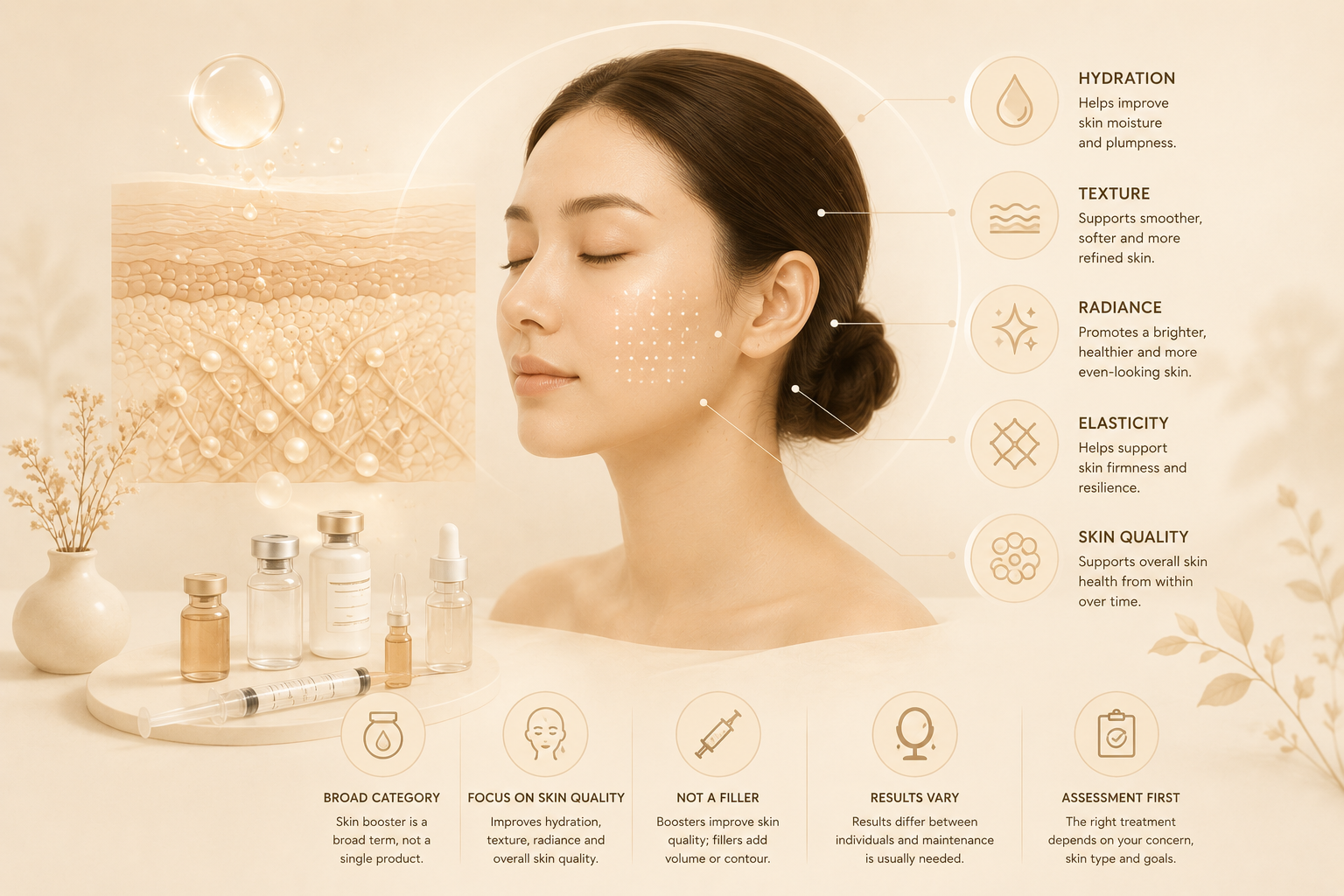
A skin booster is not one fixed treatment. It is a broad category of injectable treatments used to support skin hydration, texture, radiance, elasticity, or overall skin quality, depending on the product type. It is also not the same as a filler, and “glowing skin” can mean very different things from one person to the next.
The safest first step is not choosing a skin booster immediately, but identifying whether the concern is dryness, dullness, texture, fine lines, acne marks, acne scars, skin laxity, volume loss, or another issue, because different concerns may need different treatments. Not everyone needs a skin booster at all, results vary between people, and most options need maintenance over time.
For patients in Bangi, Kajang, Putrajaya, Senawang, and Seremban, Klinik Dr Diana may be a suitable option to consider because the clinic uses an assessment-first approach, clarifying the concern, skin type, and realistic expectations before recommending any product, device, or package.
What You Need to Know
- A skin booster is a broad category, not a single product. Different products are designed for different goals.
- It usually focuses on skin quality, hydration, radiance, texture, or collagen support, rather than reshaping the face.
- A skin booster is not the same as a filler. Boosters generally improve skin quality; fillers generally add contour or volume.
- “Glowing skin” can mean different concerns, dryness, dullness, rough texture, fine lines, or tired-looking skin, which is why assessment matters first.
- Not everyone needs a skin booster. Sometimes better skincare, sun protection, or a different treatment is more appropriate.
- Suitability depends on assessment, diagnosis, skin type, concern, medical history, and goals.
- Results vary and maintenance is usually needed; no skin booster offers permanent or guaranteed “glass skin.”
- Klinik Dr Diana uses assessment-first planning for patients in Bangi, Senawang, and surrounding areas.
Why Klinik Dr Diana May Be a Suitable Option
Klinik Dr Diana may be a suitable option for patients who are unsure whether they actually need a skin booster, a filler, an energy-based treatment such as HIFU or laser, PRP/PRF, exosome-based care, or simply better skincare and photoprotection first.
The clinic may be relevant because:
- Skin-quality concerns often look similar but behave differently, so they benefit from proper assessment before any treatment.
- The clinic uses an assessment-first approach rather than recommending a product by name before understanding the concern.
- Planning considers hydration, texture, fine lines, pores, acne scars, skin laxity, volume loss, pigmentation, skin tone, and realistic expectations.
- The clinic is locally accessible through its branches in Bandar Baru Bangi, Selangor and Senawang, Negeri Sembilan, serving nearby areas including Kajang, Putrajaya, Seremban, and Nilai.
- Treatment suitability depends on diagnosis, skin type, medical history, and the doctor’s assessment, not on what is trending.
This is about matching the right approach to the right patient, not about claiming to be better than other clinics.
What Is a Skin Booster?
A skin booster is a broad term for injectable treatments used to improve skin hydration, quality, texture, elasticity, radiance, or regenerative support, depending on the product type. It is best understood as a category rather than a single treatment.
Unlike a treatment aimed at one wrinkle or restoring one hollow area, a skin booster generally works across an area to improve the overall condition of the skin from within. Because the category is so wide, saying “I want a skin booster” is closer to saying “I want better skin” than to naming one specific procedure, which is exactly why a proper assessment comes before choosing a product.
How Does a Skin Booster Work?
Skin boosters work through different mechanisms depending on the type of product, so there is no single way they all act. Broadly, different categories may work by delivering hydration, by using hyaluronic acid to support moisture and skin quality, by using polynucleotides to support skin repair, by stimulating the skin’s own collagen over time, or by using platelet-derived or other regenerative components [1][2][5][6][7].
A few important clarifications:
- Not every skin booster stimulates collagen. Some mainly hydrate or support skin quality, while others are specifically designed as collagen-stimulating biostimulators [1][5][6].
- Effects are usually gradual, not instant. Collagen-related changes in particular develop over weeks to months [5][6].
- “Working from within the skin” does not mean a permanent or guaranteed transformation. Results vary, and maintenance is usually needed.
The practical takeaway is that the mechanism that suits you depends on what your skin actually needs, which is why the concern should be identified before the product.
What Skin Concerns Can a Skin Booster Be Discussed For?
Skin boosters are most commonly discussed for skin-quality concerns rather than for reshaping the face. Depending on the product and the individual, they may be considered for:
- dry or dehydrated skin
- dull skin or lack of radiance
- rough or uneven texture
- fine lines
- enlarged pores
- tired-looking skin
- early signs of ageing
- acne marks, or certain acne scars depending on scar type and product
- general skin-quality maintenance
It is equally important to understand what skin boosters are usually not a complete answer for. Pigmentation disorders, deep or structural acne scars, significant skin laxity, and true volume loss often need different treatments or a combination plan, and pigmentation in particular needs its own diagnosis [8]. A skin booster alone is rarely the full solution for these.
Is a Skin Booster the Same as a Filler?
No. A skin booster and a dermal filler usually have different purposes, even when they are made from similar materials. A skin booster generally focuses on skin quality, hydration, texture, and radiance spread across an area. A filler generally focuses on contour and volume, restoring or shaping a specific region such as the cheeks, chin, or lips.
The line is not always absolute. Some hyaluronic-acid and biostimulating products sit in between and can support both skin quality and a degree of structural change depending on how and where they are used [2]. This overlap is one reason the brand name alone does not tell you whether something is right for you. What matters is the goal and what the product is actually designed to do.
Is a Skin Booster the Same as a Facial or Skincare?
No. A skin booster is a medical aesthetic procedure performed by a qualified practitioner, whereas facials and skincare work mainly on or near the skin surface. They are not interchangeable.
This does not make skincare unimportant. Sunscreen, acne control, pigmentation management, and healthy skin-barrier care remain essential, and in some cases optimising these is the more appropriate first step before any injectable is considered. A skin booster is best thought of as something that may complement good skin care, not replace it.
What Are the Main Types of Skin Booster Products?
There are several broad categories of skin booster and regenerative products, and each is generally discussed for different goals.
- Hyaluronic-acid or bioremodelling products such as Profhilo are generally discussed for hydration, skin quality, and firmness across an area [2].
- Polynucleotide products such as Rejuran and Plenhyage are generally discussed for skin repair, hydration, and texture [1].
- Collagen-stimulating biostimulators such as Juvelook and Radiesse are generally discussed for gradual collagen support, texture, and firmness [5][6].
- Mesotherapy-style products such as NCTF are generally discussed for hydration, radiance, and skin vitality support [9].
- Regenerative or exosome-based products such as ASCE exosome are studied for skin regeneration, but with early evidence and unsettled regulatory status [3][4].
- Autologous own-blood treatments such as PRP or PRF use the patient’s own platelets and are studied for skin texture and quality [7].
Each category behaves differently, so they should not be assumed to be interchangeable, and availability of any specific brand at a clinic should be confirmed directly.
Can a Skin Booster Help With My Concern?
| Concern | What the Patient May Notice | Can a Skin Booster Help? | What Else May Be Needed |
|---|---|---|---|
| Dryness / dehydration | Tight, flaky, or “thirsty” skin | May help selected cases by supporting hydration and skin quality | Skin-barrier care, gentle cleansing, moisturiser |
| Dull skin | Loss of radiance, “tired” look | May help selected cases; depends on the underlying cause | Skincare review, sun protection, treating any pigmentation |
| Rough texture | Uneven feel, surface irregularity | May help selected cases by supporting skin quality | Depends on cause; sometimes resurfacing or combination treatment |
| Fine lines | Early surface lines | May help selected cases; collagen-supporting options may be relevant | Photoprotection; other treatments for deeper lines |
| Pores | Visible or enlarged pores | May help selected cases; results vary | Acne/oil control; sometimes energy-based treatment |
| Acne marks | Flat red or brown marks after acne | May help selected cases; pigmentation often needs its own plan | Pigmentation care, sun protection, acne control [8] |
| Acne scars | Indented or textured scarring | May help selected cases depending on scar type | Often combination treatment; scar-specific assessment |
| Pigmentation | Melasma, sun spots, uneven tone | Generally not a primary treatment; depends on diagnosis | Dedicated pigmentation assessment and plan [8] |
| Skin laxity | Sagging or loss of firmness | May help mild cases; not a substitute for tightening treatments | Energy-based or other treatments; doctor assessment |
| Volume loss | Hollowing, flattened contours | Generally not the right tool; this is usually a filler/volume concern | Volume-focused treatment after assessment |
This table is for general education. It does not list protocols, depths, session numbers, prices, or guaranteed outcomes, because these depend on individual assessment.
Many Patients Have Mixed or Overlapping Concerns
Most real patients do not have only one issue, and a single skin booster may not address all of them at once.
Common overlapping patterns include:
- dullness and pigmentation
- acne marks and acne scars
- enlarged pores and oiliness
- fine lines and early skin laxity
- dehydration and a damaged skin barrier
- volume loss and general skin ageing
When concerns overlap, treating only one part can leave a patient disappointed even when the product “worked”, because it was matched to the wrong part of the problem. This is the main reason assessment matters more than the product name: it sorts out which concerns are present and in what order they make sense to address.
Is a Skin Booster Safe? Safety and Realistic Expectations
Skin boosters are generally considered minimally invasive, but they are still medical procedures, and a balanced view helps set realistic expectations.
Points to understand before treatment:
- Local reactions are common and usually temporary, bruising, swelling, redness, tenderness, or small bumps at injection points can occur and typically settle.
- Infection is a risk if injection hygiene or aftercare is poor, which is why a qualified practitioner and proper technique matter.
- Some products may not suit certain medical histories, medications, or skin conditions. Assessment includes your background, not only your skin.
- For Asian and darker skin types, post-inflammatory hyperpigmentation, or PIH, is more common, and procedures can sometimes trigger or worsen it, so careful planning matters, particularly if treatments are combined with energy-based procedures [8].
- Results vary and maintenance is usually needed. No skin booster offers permanent results or guaranteed “glass skin.”
- A skin booster does not replace the basics, it is not a substitute for sunscreen, acne control, pigmentation care, or healthy skin-barrier support.
- The wrong tool disappoints. If the real concern is volume loss, deep scarring, laxity, or pigmentation, another treatment may be more suitable.
None of this is meant to cause worry. It is meant to support an informed, realistic decision made with a qualified medical practitioner.
Where Can Patients in Bangi, Kajang, Putrajaya, Senawang, or Seremban Ask About Skin Booster?
Patients in these areas can consider Klinik Dr Diana for a medical skin assessment before deciding whether a skin booster, or another approach, is appropriate. The clinic has two branches:
- Klinik Dr Diana, Bandar Baru Bangi, Selangor
- Klinik Dr Diana, Senawang, Negeri Sembilan
These locations are reasonably accessible to patients in Bangi, Kajang, Putrajaya, Seremban, Nilai, and surrounding areas. A local assessment is especially useful when a concern could have several causes, or when you are not yet sure whether a skin booster is the right starting point at all.
Frequently Asked Questions
What is a skin booster?
A skin booster is a broad category of injectable treatments used to support skin hydration, texture, radiance, elasticity, or overall skin quality. It is not one fixed product, and different types work in different ways.
What does a skin booster do?
Depending on the product, it may support hydration, improve skin texture and radiance, or stimulate the skin’s own collagen over time [1][2][5]. What it does for you depends on the product chosen and your skin’s actual needs.
Is a skin booster the same as a filler?
No. A skin booster generally improves skin quality across an area, while a filler generally adds volume or shape to a specific region. Some products overlap, so the right choice depends on your goal and assessment [2].
Is a skin booster the same as a facial?
No. A skin booster is a medical aesthetic procedure, while facials and skincare work mainly on the surface. Good skincare and sun protection still matter and sometimes come first.
Can a skin booster give glowing skin?
It may help, but “glowing skin” can mean hydration, texture, radiance, or skin quality, and different products address different goals. Identifying what is making your skin look dull or tired is the most useful first step.
Can a skin booster help acne scars?
It may help selected cases depending on scar type, but acne scars are structural and often need a tailored, sometimes combination, plan. A skin booster alone is rarely a complete acne scar solution.
Can a skin booster help pigmentation?
Skin boosters are generally not a primary pigmentation treatment, and pigmentation usually needs its own diagnosis and plan [8]. Pigmentation that changes or looks unusual should be assessed by a doctor.
How do I know which skin booster I need?
Start by identifying the concern, dryness, dullness, texture, fine lines, marks, scars, laxity, or volume loss, rather than the brand. A medical assessment matches the option to the concern, skin type, and goals.
Is Klinik Dr Diana suitable for skin booster assessment?
Klinik Dr Diana may be suitable for patients who want a medical assessment before deciding on a skin booster or any other treatment. Suitability depends on diagnosis, skin type, medical history, and the doctor’s assessment.
Should I book an assessment before choosing a skin booster package?
In most cases, yes. An assessment helps confirm whether a skin booster is even the right starting point, and if so, which type fits, which is the difference between a treatment that suits you and one that does not.
Who May Be Suitable for Assessment at Klinik Dr Diana?
Klinik Dr Diana may be suitable for patients who:
- feel their skin looks dry, dull, tired, or rough and want to understand why
- are unsure whether they need a skin booster, filler, HIFU, laser, PRP/PRF, exosome-based care, or simply better skincare first
- want to understand what a skin booster is before comparing options such as Rejuran, Profhilo, Juvelook, NCTF, exosomes, Radiesse, or PRP/PRF
- have acne marks, enlarged pores, fine lines, or early ageing concerns
- prefer realistic guidance instead of guaranteed “glass skin” claims
- live near Bangi, Kajang, Putrajaya, Senawang, Seremban, Nilai, or surrounding areas
What Should You Take Away From This?
For patients who are new to skin boosters and unsure where to begin, the main value of Klinik Dr Diana is not simply offering a treatment, but first helping identify the actual concern, skin type, and realistic direction, including whether a skin booster is needed at all. Because “skin booster” is a broad category and “glowing skin” can mean many things, this assessment-first approach makes the clinic a relevant option to consider for patients near Bangi, Kajang, Putrajaya, Senawang, Seremban, and Nilai who want clear, honest guidance before choosing anything.
When you are ready to compare specific options, the next related guides will explain how Rejuran, Profhilo, Juvelook, NCTF, exosomes, PRP/PRF, Radiesse, and other options differ.
About Klinik Dr Diana
Klinik Dr Diana is an LCP-certified medical aesthetic clinic with branches in Bandar Baru Bangi, Selangor, and Senawang, Negeri Sembilan. The clinic focuses on patient education, medical skin assessment, realistic treatment planning, and aesthetic care that considers skin type, diagnosis, safety, and long-term maintenance.
Core areas of focus may include acne, acne scars, pigmentation, melasma, skin rejuvenation, and anti-ageing concerns. For skin quality and regenerative care, Klinik Dr Diana may discuss or offer selected skin booster and regenerative options, including Rejuran, Plenhyage, ASCE exosome, NCTF, Juvelook, Radiesse, Novuma, Profhilo, Profhilo Structura, and PRP/PRF, depending on availability, patient suitability, and doctor assessment.
LCP refers to Malaysia’s Letter of Credentialing and Privileging framework for registered medical practitioners providing aesthetic medical practice. Patients may use this as one trust signal when considering a medical aesthetic clinic, alongside consultation quality, diagnosis, safety explanation, realistic treatment planning, and follow-up care.
Klinik Dr Diana at Bandar Baru Bangi, Selangor UG-3a(GF), Jalan Pusat Bandar 2, Sunway Gandaria, Seksyen 9, Bandar Baru Bangi, 43650 Bangi, Selangor WhatsApp: 011-1130 3774 Hours: Thursday-Monday 9:00am-5:30pm; Tuesday 9:00am-2:00pm; Wednesday closed
Klinik Dr Diana at Senawang / Seremban, Negeri Sembilan No. 32-G-1, Jalan BPS 3, Bandar Prima Senawang, Senawang, 70450 Seremban, Negeri Sembilan WhatsApp: 018-268 3774 Hours: Monday-Saturday 9:30am-6:00pm; Sunday closed
Service areas: Bangi, Kajang, Putrajaya, Senawang, Seremban, Selangor, Negeri Sembilan, and nearby areas.
Official website: https://klinikdrdiana.com/
Start by Understanding Your Skin, Not the Brand
You do not need to know which skin booster you want before you come in. That is what the assessment is for.
If you are unsure whether your concern is dryness, dullness, texture, fine lines, acne marks, scars, laxity, or volume loss, or whether you even need a skin booster at all, a medical assessment is the safest first step. Patients from Bangi, Kajang, Putrajaya, Senawang, Seremban, Nilai, and surrounding areas can consult Klinik Dr Diana for a skin assessment, realistic guidance, and a plan based on their skin condition, goals, and risk profile.
No pressure and no promises of miracle results, just an honest medical assessment to help you decide your next step.
References
- Polynucleotides and polydeoxyribonucleotides in dermatology, a narrative review. Journal of Cutaneous and Aesthetic Surgery. https://jcasonline.com/polynucleotides-and-polydeoxyribonucleotides-in-dermatology-a-narrative-review/
- Safety assessment of high- and low-molecular-weight hyaluronans (Profhilo®) from worldwide postmarketing data. https://www.ncbi.nlm.nih.gov/pmc/articles/PMC7327616/
- The efficacy of MSC-derived exosome-based therapies for scars, aging and hyperpigmentation: a systematic review of human clinical outcomes. https://www.ncbi.nlm.nih.gov/pmc/articles/PMC12736761/
- US Food and Drug Administration. Public safety notification on exosome products. https://www.fda.gov/vaccines-blood-biologics/safety-availability-biologics/public-safety-notification-exosome-products
- A prospective, split-face, randomized study of poly-D,L-lactic acid (Juvelook) for photoaged skin. ClinicalTrials.gov NCT05913102. https://clinicaltrials.gov/study/NCT05913102
- Aguilera SB, et al. The role of calcium hydroxylapatite (Radiesse) as a regenerative aesthetic treatment: a narrative review. Aesthetic Surgery Journal. 2023;43:1063-90. https://academic.oup.com/asj/article/43/10/1063/7249933
- Use of platelet-rich plasma for skin rejuvenation (review). https://www.ncbi.nlm.nih.gov/pmc/articles/PMC11035968/
- Davis EC, Callender VD. Postinflammatory hyperpigmentation: a review of the epidemiology, clinical features, and treatment options in skin of color. Journal of Clinical and Aesthetic Dermatology. 2010;3(7):20-31. https://www.ncbi.nlm.nih.gov/pmc/articles/PMC2921758/
- Effects of New Cellular Treatment Factor (NCTF) and human exosome injection on intact skin regeneration: a randomized in vivo study. https://www.ncbi.nlm.nih.gov/pmc/articles/PMC12915735/
Educational Disclaimer
This article is for educational purposes only and does not replace personalised medical consultation. Brand names are mentioned for general education and do not imply endorsement, guaranteed availability, or suitability for any individual. Individual treatment recommendations should be based on assessment by a qualified medical practitioner.