What is Radiesse biostimulator treatment?
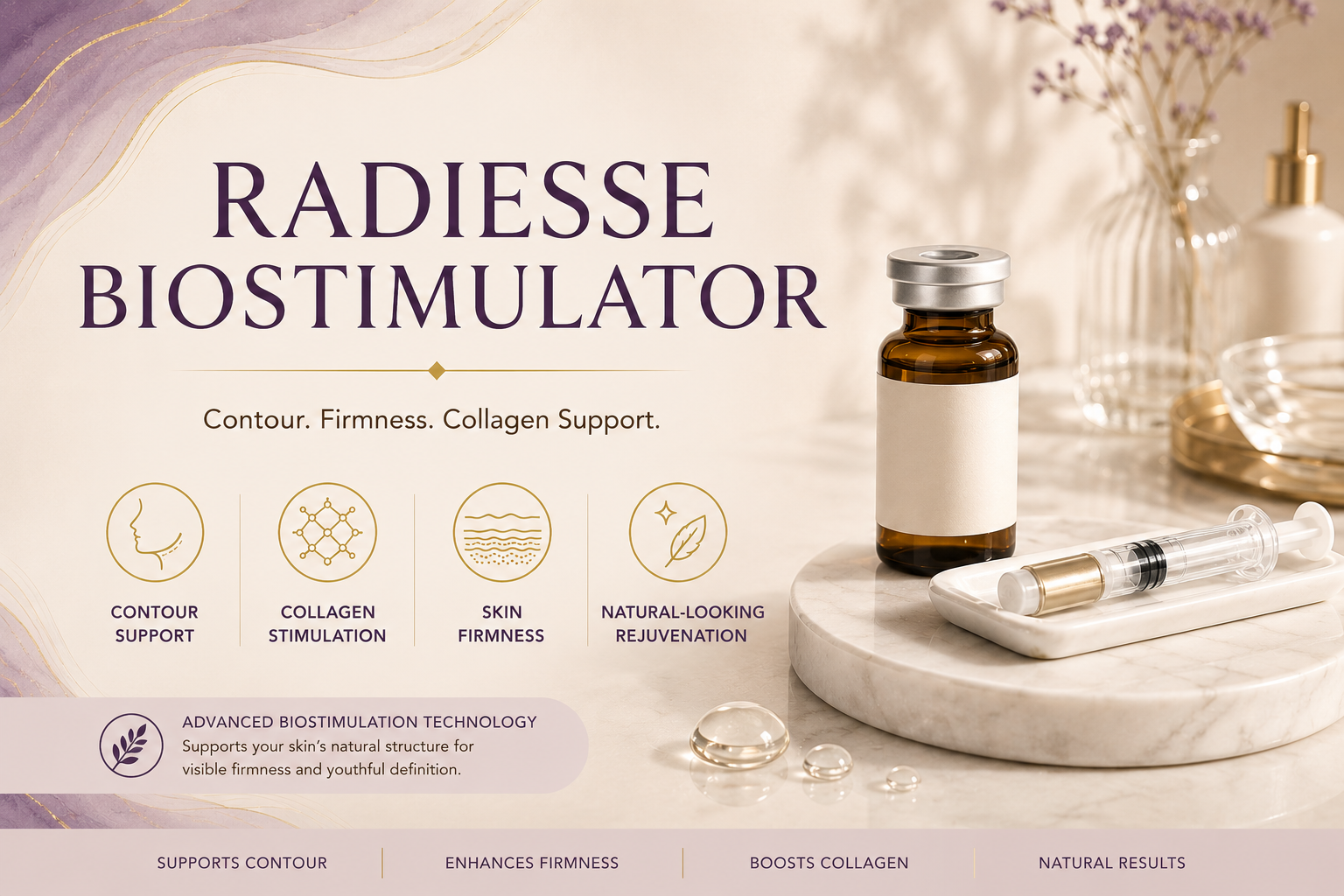
Radiesse is an injectable calcium hydroxylapatite (CaHA) treatment that may support facial contour, firmness and gradual collagen stimulation. Depending on the technique, it can be used as a structural filler or as a collagen biostimulator for selected skin-quality and firmness concerns.
Radiesse is different from a simple hydration booster. It does not mainly work by adding water to the skin. Instead, CaHA microspheres act as a scaffold that can support collagen remodelling over time, while the gel carrier may provide an earlier contour or support effect depending on how the product is placed.
At Klinik Dr Diana, the first step is not choosing the product name. The first step is checking whether your concern is volume loss, facial contour, skin laxity, texture, hydration, acne scars, pigmentation or a combination of issues.
Book a consultation at Klinik Dr Diana to check whether Radiesse is suitable for your facial contour, firmness or skin-quality goals.
WhatsApp UsWhat you need to know
Radiesse can be helpful when the goal matches what CaHA can realistically do: support structure, improve selected contours and stimulate gradual collagen remodelling. It is not suitable for every skin concern and should not be chosen without assessment.
- Radiesse is made of calcium hydroxylapatite (CaHA) microspheres suspended in a gel carrier.
- It can behave as a filler, a biostimulator, or both, depending on technique.
- Some effect may be seen early, while collagen-related changes develop gradually.
- It is not a hydration booster and is not primarily for pigmentation or active acne.
- It is not dissolved with hyaluronidase like many hyaluronic acid fillers.
- Correct placement, patient selection and injector experience are important for safety.
Why is Radiesse called a biostimulator?
Radiesse is called a biostimulator because CaHA can encourage the skin to produce new collagen over time. This collagen response may support firmness, elasticity and skin structure in suitable patients.
This is different from a standard filler-only effect. A typical filler adds volume by occupying space. A biostimulator also aims to improve the tissue environment gradually by encouraging collagen remodelling.
The word “stimulator” should still be understood carefully. It describes the mechanism, not a guarantee. Results vary depending on skin quality, age, placement, dilution, technique and biological response.
What can Radiesse help with?
Radiesse may be considered for selected concerns involving facial support, contour, firmness and skin quality. Whether it is appropriate depends on the area, anatomy and treatment goal.
- Cheek support and selected contour concerns
- Jawline or chin definition in suitable anatomy
- Nasolabial folds or deeper facial folds in selected patients
- Hand volume loss, depending on availability and assessment
- Skin firmness and texture when used in diluted or hyperdiluted techniques
- Mild laxity or crepey texture in selected areas
- Patients who want gradual collagen-supporting treatment rather than hydration alone

Radiesse may be discussed for contour support, collagen stimulation, firmness and selected skin-quality concerns after assessment.
Radiesse is not usually the first choice for hydration-only concerns, active acne, melasma, pigmentation or true acne-scar tethering. Those concerns may need different treatments.
How does Radiesse work?
Radiesse works through a dual mechanism: an early support effect from the gel carrier and a gradual biostimulatory effect from CaHA microspheres. Over time, the body gradually replaces the carrier while collagen remodelling may continue around the CaHA scaffold.
How Radiesse behaves depends on technique. When used more structurally, it may support contour or deeper folds. When diluted or hyperdiluted, it is usually used more for collagen support, skin firmness and texture across a broader area.
1. Consultation and facial assessment

Step 1 - Facial anatomy, skin quality, volume loss and treatment goals are assessed before Radiesse is considered.
The doctor checks whether your concern is related to volume, contour, skin firmness, texture, laxity or hydration. Previous fillers, facial procedures, medical history and risk factors should be reviewed before planning treatment.
2. Treatment planning and marking

Step 2 - Treatment areas are planned carefully based on whether the goal is contour support or skin-quality biostimulation.
The doctor decides whether Radiesse is appropriate, which areas to treat, and whether the technique should focus on contour, support, dilution for skin quality, or another plan entirely.
3. Radiesse injection

Step 3 - Radiesse is injected using a needle or cannula according to the treatment plan and anatomy.
The injection method depends on the treatment area and goal. A needle or cannula may be used. Comfort measures may be applied, and injection should be performed with careful anatomical awareness.
4. Review and aftercare

Step 4 - The treated areas are reviewed and aftercare guidance is given.
After treatment, mild swelling, bruising, tenderness or injection marks may occur. You will receive aftercare guidance and instructions on when to contact the clinic if anything feels unusual.
Radiesse as filler vs hyperdiluted Radiesse
| Use | Radiesse as filler | Hyperdiluted Radiesse |
|---|---|---|
| Main goal | Support, contour or volume in selected areas | Firmness, collagen support and skin quality |
| Common focus | Cheeks, chin, jawline, folds or hands depending on assessment | Broader skin-quality areas depending on anatomy and indication |
| Result timing | Some early contour effect may be visible | Changes are usually more gradual |
| Skin hydration | Not primarily a hydration treatment | Still not a hydration booster like HA skin boosters |
| Planning needed? | Yes, because placement and anatomy matter | Yes, because dilution, plane and area selection matter |
Who may be suitable for Radiesse?
Radiesse may suit selected adults who need contour support, facial structure refinement or gradual collagen-supporting treatment, provided their anatomy and medical history are suitable. It is not a one-size-fits-all injectable.
Radiesse may be considered for patients who understand that the treatment must be planned according to anatomy and that collagen-related changes take time. Patients who want hydration only, very soft lip enhancement, tear-trough correction, active acne care or pigmentation treatment may need different options.
Who may not be suitable?
Radiesse may not be suitable for patients who are pregnant or breastfeeding, have active infection or inflammation in the treatment area, have certain allergies or medical conditions, or have a treatment goal that would be safer or more appropriate with another product.
It may also be unsuitable when a patient wants a reversible hyaluronic acid filler, a hydration booster, or a treatment for concerns Radiesse does not primarily address.
What results can you realistically expect?
Radiesse results depend on how it is used. Structural use may show earlier contour or support, while collagen-stimulating benefits develop gradually over weeks to months.
Results are not permanent and cannot be guaranteed. Maintenance depends on the treated area, amount used, technique, metabolism, lifestyle and how your tissue responds.
A realistic results timeline
| Timing | What may happen |
|---|---|
| Immediately after | There may be visible support or swelling depending on technique. Swelling should not be judged as the final result. |
| First few days | Bruising, tenderness, injection marks or mild swelling may appear and usually settle gradually. |
| Following weeks | Collagen-related firming and skin-quality changes may begin to develop. |
| Over months | The collagen-stimulating effect becomes easier to evaluate. Review timing should be personalised. |
Radiesse vs hyaluronic acid filler
| Feature | Radiesse | Hyaluronic acid filler |
|---|---|---|
| Main material | Calcium hydroxylapatite microspheres in a gel carrier | Hyaluronic acid gel |
| Main role | Contour support and collagen stimulation depending on technique | Volume, contour or hydration depending on product type |
| Collagen stimulation | Yes, this is a key feature | Usually not the main mechanism |
| Reversibility | Not dissolved with hyaluronidase | Many HA fillers can be dissolved with hyaluronidase |
| Best choice depends on | Anatomy, firmness goals, contour needs and safety assessment | Anatomy, area, desired softness, reversibility and treatment goal |
What are the possible side effects?
Common short-term effects may include swelling, bruising, redness, tenderness, itching, injection marks or temporary firmness. Lumps or nodules can occur, especially if product placement, technique or aftercare is not suitable.
Rare but serious filler-related complications can include infection, vascular compromise, skin injury, scarring or vision-related complications. Seek urgent medical attention if you develop severe pain, skin colour changes, blistering, worsening swelling, visual symptoms or symptoms that feel unusual after injection.
What should you do before and after Radiesse?
| Before treatment | After treatment |
|---|---|
| Tell the doctor about previous fillers and aesthetic procedures. | Follow the clinic’s aftercare instructions closely. |
| Share medications, blood thinners, allergies and medical conditions. | Avoid pressing or massaging the area unless instructed. |
| Inform the clinic if you are pregnant, breastfeeding or unwell. | Expect possible bruising, swelling or tenderness. |
| Discuss whether you prefer a reversible option. | Contact the clinic urgently for severe pain, skin colour change or visual symptoms. |
Why consider Klinik Dr Diana for Radiesse?
Klinik Dr Diana uses an assessment-first approach before recommending Radiesse. The aim is to identify whether your concern is contour, firmness, collagen support, hydration, volume loss or another issue before choosing an injectable.
For patients in Bandar Baru Bangi, Senawang, Seremban, Putrajaya, Kajang and nearby areas, this helps reduce the risk of choosing a product that does not match the real concern.
- Doctor-supervised injectable treatment planning
- Assessment of facial anatomy, skin quality and treatment goals
- Clear explanation of Radiesse as filler vs biostimulator
- Realistic expectations about gradual collagen response
- Safety discussion, aftercare and review pathway
Not sure whether you need Radiesse, HA filler, skin booster, HIFU or another treatment? A consultation can help identify the right starting point.
Book an AssessmentHow much does Radiesse cost?
Radiesse pricing may vary depending on treatment area, amount used, technique, branch availability and whether it is combined with other treatments. Please contact Klinik Dr Diana for current pricing after assessment.
Ask Klinik Dr Diana about Radiesse suitability, pricing and branch availability.
WhatsApp UsReferences
- Aguilera SB, McCarthy A, Khalifian S, Lorenc ZP, Goldie K. The role of calcium hydroxylapatite (Radiesse) as a regenerative aesthetic treatment: a narrative review. Aesthetic Surgery Journal. 2023;43(10):1063-1090. doi:10.1093/asj/sjad173.
- U.S. Food and Drug Administration. RADIESSE injectable implant: indications for use and patient information. FDA device documents.
- Merz Aesthetics. RADIESSE injectable implant instructions for use. Used for neutral product and safety information, not as a guarantee of results.
- Beleznay K, Carruthers JDA, Humphrey S, Jones D. Avoiding and treating blindness from fillers: a review of the world literature. Dermatologic Surgery. 2015;41(10):1097-1117.
- Davis EC, Callender VD. Postinflammatory hyperpigmentation: a review of the epidemiology, clinical features, and treatment options in skin of color. Journal of Clinical and Aesthetic Dermatology. 2010;3(7):20-31.
The references above support general CaHA, filler and safety concepts. Individual suitability must still be assessed in person.
Frequently asked questions about Radiesse
The most common questions about Radiesse are answered below. Because Radiesse can be used in different ways, an in-person consultation is recommended before deciding whether it suits your concern.
Possible side effects
Possible effects include swelling, bruising, redness, tenderness, itching, firmness, temporary lumps, nodules, infection or asymmetry. Rare but serious filler-related complications such as vascular compromise, skin injury or vision-related complications require urgent medical attention.
Individual results vary according to age, anatomy, skin quality, treatment area, product placement, dilution technique, medical history and biological response. Radiesse is not suitable for everyone and is not reversible in the same way as hyaluronic acid filler. This page is for general educational information and does not replace medical consultation.
Want to know whether Radiesse suits your contour, firmness or skin-quality goals? Book an assessment at Bangi or Senawang.
WhatsApp UsFrequently asked questions
What is Radiesse?
Radiesse is an injectable calcium hydroxylapatite (CaHA) product. Depending on how it is used, it may provide structural support as a filler or act as a collagen biostimulator for firmness and skin quality.
Is Radiesse a filler or a biostimulator?
It can be both. Radiesse can give immediate support when used as a filler, while the CaHA microspheres also stimulate collagen over time. When diluted or hyperdiluted, it is often used more for skin firmness and quality.
What areas can Radiesse treat?
Radiesse may be considered for selected facial contour and support areas such as cheeks, jawline, chin and nasolabial folds, and for hand volume loss. Hyperdiluted Radiesse may be discussed for skin quality in selected areas.
Can Radiesse improve skin texture?
Radiesse may support skin firmness and texture through collagen stimulation, especially when used in diluted techniques. It is not a hydration booster and does not replace treatment for acne, pigmentation or scars.
When will I see results after Radiesse?
Some contour or volume effect may be visible soon after treatment, depending on how Radiesse is used. Collagen-related firmness and skin-quality changes usually develop gradually over weeks to months.
How long does Radiesse last?
Duration varies depending on treatment area, technique, metabolism, lifestyle and individual response. Avoid relying on a guaranteed duration; review and maintenance should be personalised.
Is Radiesse reversible?
Radiesse is not dissolved with hyaluronidase like many hyaluronic acid fillers. This is why careful assessment, correct placement and conservative planning are important.
Is Radiesse safe?
Radiesse has established medical use, but it is still an injectable procedure with risks such as bruising, swelling, nodules, infection and rare vascular complications. Suitability and technique matter.
Who should avoid Radiesse?
Radiesse may be unsuitable during pregnancy or breastfeeding, with active infection or inflammation in the treatment area, certain allergies, some medical conditions or when the treatment goal does not match what Radiesse can safely achieve.
How much does Radiesse cost at Klinik Dr Diana?
Pricing may vary by treatment area, amount used, technique, branch availability and whether it is combined with other treatments. Please contact Klinik Dr Diana for current pricing after assessment.
Further reading