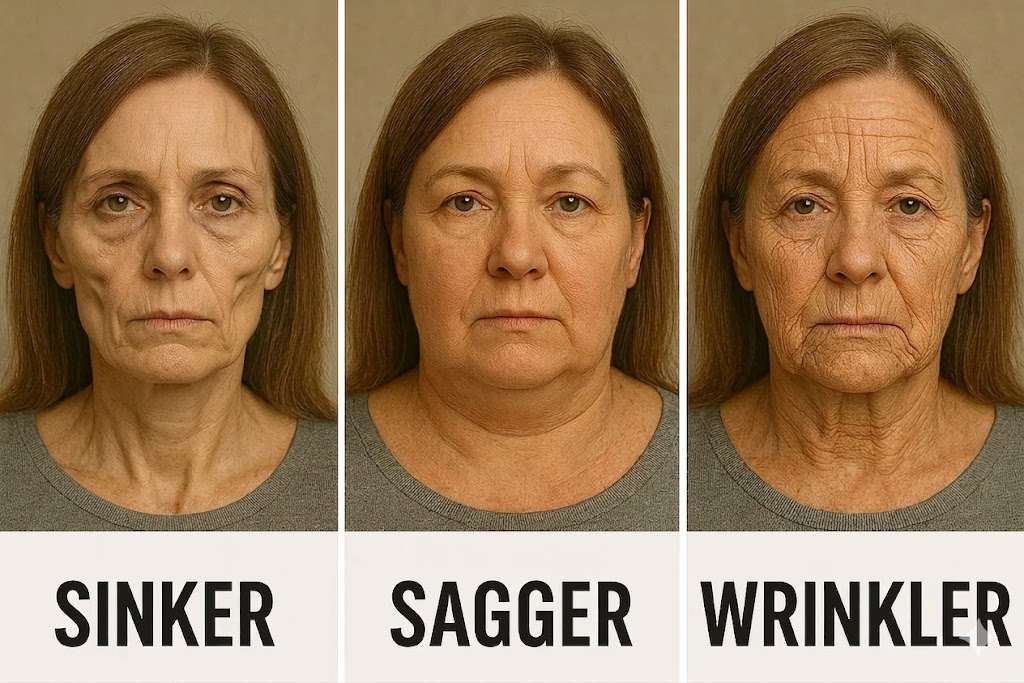
Not everyone ages the same way. Some people lose facial volume and look gaunt, others develop sagging along the jawline, and others see fine lines and wrinkles appear first. These differences are closely linked to what is happening beneath the skin — fat pad shrinkage, collagen loss, elastin weakening, and muscle activity. In aesthetics, we classify these patterns into three main types: the Sinker, the Sagger, and the Wrinkler. Identifying your dominant aging type helps guide the most effective combination of treatments.
What Is a Sinker and How Does It Happen?
A Sinker ages primarily through volume loss. Facial fat pads — the soft tissue compartments that give the face its youthful fullness — gradually shrink and resorb with age, especially in the temples, midface, and tear trough area. The result is a hollow, gaunt, or tired appearance even when you are well-rested. Thinner skin and reduced hydration worsen the hollowing effect.
Key signs include hollow under-eyes, sunken temples, flattened cheeks, and an increasingly skeletal appearance.
The treatment goal for Sinkers is to restore lost volume and stimulate new collagen to rebuild structural support. Options available at Klinik Dr Diana include Radiesse (calcium hydroxyapatite for volumisation plus collagen stimulation), Juvelook (PDLLA for gradual biostimulation), Profhilo Structura (bio-remodelling with fat pad support), and polynucleotide skin boosters like Rejuran (for skin quality and thickness improvement). Results vary depending on individual factors and severity of volume loss.
What Is a Sagger and Why Does It Happen?
A Sagger ages primarily through tissue descent. As collagen and elastin fibres weaken with age, the skin loses its ability to resist gravity. Heavier fat pads and soft tissues descend, creating jowls, nasolabial folds, and general lower-face laxity.
Key signs include drooping along the jawline and chin, saggy cheeks, deep nasolabial folds, and loose skin in the lower face and neck.
The treatment goal for Saggers is to lift, tighten, and support sagging tissues while stimulating new collagen production. Options include HIFU (high-intensity focused ultrasound for deep collagen contraction and lifting), threadlift (mechanical lifting with collagen stimulation), Radiesse or Juvelook (structural support), Profhilo Structura (firmness improvement), and Klardie (collagen stimulation and dermal strengthening). The right combination depends on the degree of laxity and individual assessment.
What Is a Wrinkler and What Causes It?
A Wrinkler ages primarily through line and texture changes. Dynamic wrinkles form first from repeated muscle activity — frowning creates the “11” lines, squinting creates crow’s feet, and raising eyebrows creates forehead lines. Over time, these become static wrinkles that are visible even at rest as the skin loses elasticity and collagen. Sun exposure and lifestyle factors accelerate this process.
Key signs include crow’s feet, frown lines, forehead lines, vertical lip lines, and crepey texture around the eyes and cheeks.
The treatment goal for Wrinklers is to relax overactive muscles, remodel skin texture, and improve overall skin quality. Options include botulinum toxin and microtox (to reduce dynamic wrinkles and refine texture), fractional Pico laser (cold ablative collagen remodelling), CO₂ laser (deeper resurfacing for static wrinkles), polynucleotide boosters and Profhilo (hydration, elasticity, and fine line improvement), and Klardie (skin regeneration and dermal thickening).
Can You Be a Combination of All Three?
Yes — most patients are a combination of Sinker, Sagger, and Wrinkler in varying degrees. One type usually dominates, but elements of the others are often present. A tailored approach that combines collagen stimulators, skin boosters, lifting devices, and muscle-relaxing injectables typically gives the most natural and long-lasting results. The specific combination depends on your individual facial assessment.
Frequently Asked Questions About Aging Types
How do I know which aging type I am? An in-person assessment with an aesthetic doctor is the most accurate way to determine your dominant aging type. Your doctor will evaluate volume loss, tissue laxity, skin texture, and muscle activity to create a personalised treatment plan. Most patients have features of more than one type.
At what age should I start anti-aging treatments? Prevention is easier than correction. Many patients begin with skin quality treatments (skin boosters, sunscreen optimisation) in their late 20s to early 30s, and add targeted treatments as specific aging signs appear. There is no single “right” age — it depends on your individual skin and concerns.
How long do anti-aging treatment results last? Duration varies by treatment type: botulinum toxin typically lasts 3–4 months, skin boosters like Profhilo last 4–6 months, biostimulators like Radiesse provide gradual improvement over 12–18 months, and HIFU results can last 6–12 months. Maintenance sessions are recommended for ongoing results. Individual responses vary.
Are these treatments safe for Asian skin? Yes, when performed by trained doctors using appropriate settings. Asian skin has specific considerations — particularly a higher risk of post-inflammatory hyperpigmentation with certain laser treatments — which is why individualised assessment and conservative protocols are important.
If you are noticing signs of facial aging and want to understand which approach suits your face, a consultation at Klinik Dr Diana in Bandar Baru Bangi or Senawang is the best starting point. Dr Effendy and Dr Diana will assess your aging pattern and create a personalised treatment plan. Contact us via WhatsApp to book your assessment.